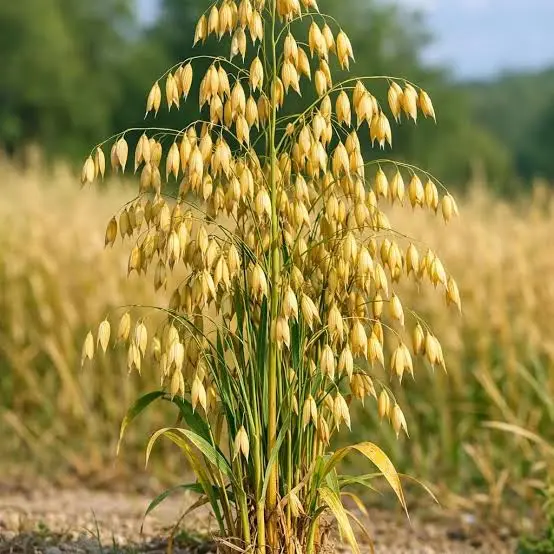
🌾 Can Chickens Eat Oats? Growing Oats for Chickens
Oats are a versatile cool-season grain and forage crop that can provide fresh green forage, whole seed heads for chicken enrichment, and carefully processed grain for supplemental feeding. This guide explains whether chickens can eat oats, how to grow them, harvest them, dry them, and use them safely in a backyard chicken system.
🌾 Can Chickens Eat Oats?
Yes. Chickens can eat clean oats in several forms, including whole raw oats, plain cooked oatmeal, oat sprouts, tender oat grass, and thoroughly dried mature seed heads. Oats should remain a supplemental food alongside a complete poultry ration rather than replacing balanced feed.
Adult chickens may eat clean whole raw oats when appropriate insoluble grit is available. Oats do not need to be cooked before feeding, although their attached hull makes ordinary whole oats relatively high in fiber and lower in usable energy than grains such as corn or grain sorghum.
Chickens may also eat plain cooked oatmeal after it has cooled. Serve it without sugar, salt, milk, butter, oils, sweeteners, flavorings, or other added ingredients. Cooked oatmeal is best offered occasionally because it is easy to overfeed and does not provide complete poultry nutrition.
Other practical oat options include:
- Young oat grass: Tender leaves and shoots may be offered through controlled grazing, cut-and-carry feeding, or a protected forage frame.
- Oat sprouts: Clean, untreated oats may be sprouted and offered as supplemental green forage when sanitation, rinsing, drainage, and mold prevention are carefully maintained.
- Whole mature seed heads: Thoroughly dried, untreated seed heads may be offered as pecking enrichment.
- Loose whole grain: Mature oats may be dried, threshed, cleaned, and offered in measured amounts to adult chickens.
- Coarsely processed oats: Grinding or cracking can change particle size, but it does not remove the hull, reduce beta-glucans, or make oats nutritionally complete.
Oats do not provide enough calcium, balanced amino acids, vitamins, minerals, or concentrated energy to replace chick starter, grower feed, layer feed, or another properly formulated poultry ration. Never feed moldy, musty, heated, rancid, chemically treated, or contaminated oats.
Are Oats a Good Crop to Grow for Chickens?
Oats are a versatile cool-season cereal crop that can provide leafy forage, mature seed heads, dry grain, seasonal ground cover, erosion control, and soil-building biomass. They complement warm-season feed crops such as grain sorghum, proso millet, and field corn.
Their main limitations are high hull fiber, lower usable poultry energy than corn or sorghum, beta-glucans, winter-kill risk, lodging, disease, wild-bird pressure, processing labor, and the need for careful drying and storage.
Is Oats the Right Crop for Your Flock and Backyard?
Oats may be a strong choice for one property and a poor fit for another. Climate, winter temperatures, growing space, sunlight, soil, water, flock access, drying ability, processing tasks, equipment, harvest goals, and storage all affect whether oats are practical.
🌱 Use the Feed Crop Planner →📋 Oats Quick Facts
🌱 Know What Kind of Oats You Are Growing
The word “oats” may describe several products that are not nutritionally or practically identical.
Ordinary Hulled Oats
The hull remains attached to the grain after normal harvesting and threshing.
These oats are higher in fiber and lower in usable poultry energy than dehulled or hull-less oats.
Hull-Less or Naked Oats
These varieties lose most of their hull during harvesting.
They are generally lower in fiber and higher in protein, fat, and energy than ordinary hulled oats.
Oat Groats
Groats are oat kernels from which the hull has been mechanically removed.
Purchased groats should not be assumed to have the same nutrition or storage characteristics as homegrown whole hulled grain.
Do not apply hull-less-oat or groat feeding values to ordinary mature oats unless you know which product you have.
🐔 Four Practical Ways to Use Homegrown Oats
🌱 Young Oat Forage
Allow chickens controlled access to established young plants or cut leafy growth and carry it to the flock.
Best for seasonal greens and enrichment rather than long-term storage.
🌾 Whole Dried Seed Heads
Cut mature seed heads, finish drying them under cover, and offer them as pecking enrichment.
This avoids threshing but still requires careful drying and protected storage.
🪣 Loose Whole Grain
Dry, thresh, winnow, and clean mature grain for measured supplemental feeding.
This is the strongest long-storage oat path but requires the most hand processing.
Clean whole oats may be ground or coarsely processed, but broken grain has more exposed surface area and generally should not be stored as long as intact grain.
🗓 When to Plant Oats
Oats grow during cool weather, but planting strategy varies by region.
In colder climates, oats are commonly planted during early spring as soon as the soil is workable. In mild-winter regions, adapted oats may be planted during fall for winter forage or a late-spring grain harvest.
| Region | General Planting Approach | Likely Use or Harvest |
|---|---|---|
| Cold North | Plant spring oats as soon as the soil can be worked without severe compaction. Ordinary fall-planted oats commonly winter-kill. | Spring forage followed by summer grain harvest. |
| Midwest and Northeast | Plant very early in spring so the crop establishes before summer heat. | Spring forage or midsummer grain harvest. |
| Upper South | Plant during the locally recommended fall window and choose a variety with suitable winter hardiness. | Fall, winter, and spring forage followed by late-spring or early-summer grain. |
| Deep South | Plant during fall for winter and spring growth. Forage oats may be planted earlier than grain oats. | Cool-season forage and late-spring grain. |
| Southwest | Plant during the coolest practical season where dependable moisture or irrigation is available. | Cool-season forage or spring grain before extreme heat. |
| Pacific Northwest | Use spring planting in colder interior locations. Locally adapted fall oats may work in milder areas. | Spring forage and summer grain. |
| Coastal West | Plant during the cool rainy season in mild climates or early spring where frost and saturated soil are concerns. | Cool-season forage or grain harvested before prolonged damp weather. |
Planting too late may produce weak plants that are vulnerable to winter injury. Planting too early in fall can encourage excessive growth, disease, insects, lodging, or premature head formation.
❄️ Understanding Oat Winter Hardiness
Oats are generally less winter hardy than rye, wheat, and barley. However, cold tolerance varies significantly by variety, establishment, growth stage, soil conditions, snow cover, wind exposure, and duration of cold.
Southern Extension guidance warns that oats may suffer substantial yield loss when temperatures fall below approximately 20°F.
Winter survival can be improved by:
- Choosing a locally recommended winter-hardy variety
- Planting during the correct regional window
- Establishing a healthy root system before severe cold
- Avoiding poorly drained frost pockets
- Maintaining suitable soil fertility
- Avoiding excessive nitrogen and overly lush fall growth
- Using spring oats where winter survival is unreliable
However, a winter-killed stand will not provide the intended spring forage or mature grain harvest.
📐 How Much Space Do Oats Need?
Oats are normally planted as a continuous stand rather than as individually spaced garden plants.
They may be grown in:
- Garden rows
- Broadcast beds
- Raised beds
- Small grain plots
- Unused lawn areas
- Open fields
- Seasonal paddocks
- Protected forage frames
| Growing Area | Best Practical Use | Important Limitation |
|---|---|---|
| Small container or tray | Temporary young green forage | Usually inefficient for meaningful mature grain production. |
| Small raised bed | Forage, education, or whole seed-head enrichment | The total amount of stored grain will be limited. |
| Medium garden plot | Protected forage plus a small seed-head harvest | Bird pressure and hand processing may remove much of the practical value. |
| Large plot or field | Forage, cover cropping, whole heads, or loose stored grain | Harvesting, threshing, drying, and storage become larger jobs. |
The database intentionally does not promise a specific number of pounds per 100 square feet. Backyard yield depends on variety, planting date, stand density, soil fertility, moisture, weeds, disease, lodging, wild birds, harvest timing, threshing efficiency, hull percentage, and final grain moisture.
🪴 How to Plant Oats
- Choose a sunny growing area. Provide at least six hours of direct sunlight, with longer full-sun exposure preferred for strong grain production.
- Choose the right seasonal strategy. Use spring oats in severe-winter climates or adapted fall oats in mild-winter regions.
- Prepare a clean seedbed. Remove established weeds, reduce severe compaction, and create reasonably firm soil with good seed contact.
- Plant approximately 1–1½ inches deep. Avoid leaving seed exposed to birds or burying it deeply in cold, wet soil.
- Broadcast evenly or plant in rows. Broadcasting creates a natural stand, while rows make hand weeding and observation easier.
- Firm the seedbed lightly. Good soil contact supports more even moisture and emergence.
- Maintain moisture through establishment. Do not allow the seed zone to dry completely during germination.
- Protect the stand from chickens. Do not permit unrestricted flock access while plants are emerging and establishing.
🐥 Growing Oats in a Forage Frame
A forage frame is one of the most practical ways to let chickens eat young oats without destroying the roots.
A simple frame uses:
- A shallow raised border
- Prepared soil
- Oat seed planted beneath the cover
- Strong wire mesh attached above the soil
- Openings large enough for chickens to reach leaves
- Openings small enough to prevent full scratching access
As oat leaves grow through the mesh, chickens can clip the tops while the roots and crowns remain partially protected.
Heavy pecking, heat, drought, poor fertility, compaction, disease, and repeated close defoliation may weaken or kill the stand. Rotate or rest frames when growth slows.
🌱 Allowing Chickens to Graze Oats
Oats may provide controlled cool-season forage after the stand becomes well established.
Possible access methods include:
- Short rotational access
- Temporary fencing
- Multiple small paddocks
- Protected forage frames
- Cut-and-carry harvesting
Unrestricted chickens may:
- Eat seedlings before roots develop
- Pull plants from loose soil
- Scratch seed out of the ground
- Compact wet soil
- Overgraze leaves
- Prevent stem and seed-head development
Heavy forage use and mature grain production compete with each other. Protect at least part of the planting if you want to harvest seed heads.
🌱 Soil and Fertility
Oats perform best in moderately well-drained to well-drained soil. University of Minnesota guidance identifies a productive soil-pH range of approximately 5.5–7.0.
Suitable soils may include:
- Loam
- Silt loam
- Clay loam with dependable drainage
- Sandy loam with adequate moisture and fertility
A soil test should guide:
- Soil-pH correction
- Nitrogen
- Phosphorus
- Potassium
- Sulfur
- Organic-matter management
Oats capture available soil nitrogen but do not fix atmospheric nitrogen like clover, alfalfa, or cowpeas.
Too much nitrogen may create lush weak growth, increase lodging, delay maturity, and encourage certain diseases.
💧 Watering Oats
Oats generally perform best under cool conditions with dependable moisture.
Water is especially important during:
- Germination
- Seedling establishment
- Tillering
- Stem elongation
- Heading
- Flowering
- Grain filling
Rainfall-only production may be practical in climates with dependable cool-season precipitation. Hot, dry regions may require irrigation and careful seasonal timing.
Oats are not as drought resilient as Proso Millet or Grain Sorghum. Water stress during heading and grain filling may reduce seed number, kernel size, and final yield.
Oats may handle cool damp weather better than some grains, but prolonged standing water and poorly aerated soil can still damage roots and reduce stand health.
🌿 Controlling Weeds
A healthy dense oat stand may suppress some later weeds, but early weed competition can reduce establishment, forage growth, tillering, and grain yield.
Useful practices include:
- Starting with a clean seedbed
- Using clean seed
- Planting at an appropriate stand density
- Using rows where hand cultivation is planned
- Removing aggressive weeds before they produce seed
- Avoiding repeated soil disturbance after the oat stand fills in
- Rotating crops rather than growing oats continuously
Use only weed-control products labeled for oats and the intended crop use. Observe all grazing, harvest, and feeding restrictions.
🌬 Preventing Oats from Lodging
Lodging occurs when oat stems bend or fall before harvest.
Lodging may be encouraged by:
- Excess nitrogen
- Overly dense planting
- Tall weak-strawed varieties
- Heavy rain
- Strong wind
- Disease
- Wet soil and weak roots
- Delayed harvest
Reduce risk by selecting an adapted variety with good straw strength, using balanced fertility, avoiding excessive stand density, and harvesting promptly after maturity.
🐛 Common Oat Pests
| Problem | What You May Notice | Possible Response |
|---|---|---|
| Cereal leaf beetle | Windowpane-like leaf feeding, stripped leaves, or dark slug-like larvae | Scout regularly and follow current local Extension thresholds and recommendations. |
| Aphids | Clusters of small insects, leaf yellowing, sticky residue, or reduced vigor | Monitor populations and consider virus risk when evaluating management. |
| Armyworms | Ragged leaves, clipped seedlings, or caterpillars hidden near the soil or within the canopy | Inspect during evening and early morning and use labeled controls only when justified. |
| Wild birds | Missing grain, bent heads, scattered chaff, or birds feeding directly on panicles | Use supported netting, deterrents, protected drying, or timely harvest. |
| Rabbits and deer | Clipped plants, browsed leaves, tracks, or uneven missing forage | Use fencing or protected plantings. |
| Stored-grain insects | Holes, dust, webbing, larvae, adult insects, or heating grain | Store only clean dry grain and inspect containers regularly. |
Loose netting can entangle chickens, wild birds, snakes, and other wildlife.
🦠 Oat Diseases
| Problem | What You May Notice | Why It Matters |
|---|---|---|
| Crown rust | Orange, yellow, or brown pustules on leaves | Reduces photosynthesis, plant strength, forage quality, and grain production. |
| Stem rust | Elongated reddish-brown pustules on stems and leaves | May weaken stems and reduce grain fill. |
| Loose smut | Seed head replaced by dark powdery fungal spores | Destroys grain-producing portions of the head. |
| Leaf blotches | Tan, brown, gray, or irregular dead areas on leaves | Severe infection may reduce plant vigor and yield. |
| Barley yellow dwarf and related viruses | Yellowing, reddening, stunting, reduced tillering, or poor head formation | May substantially reduce forage and grain production. |
| Field molds | Discolored kernels, weathered heads, visible fungal growth, or musty odor | Reduces grain quality and may create feed-safety concerns. |
Appearance and odor cannot reliably prove that grain is free from harmful fungal toxins. Discard suspicious grain or seek professional testing when contamination is possible.
🔎 How to Tell When Oats Are Mature
Oats produce a branching seed head called a panicle.
As the crop matures:
- The panicle loses much of its green color
- Stems and leaves begin yellowing and drying
- Grain develops its final size
- Kernels change from soft and milky to firm
- The hull becomes dry and papery
- Mature grain separates more readily after drying
Physiological maturity does not automatically mean the grain is dry enough for sealed storage.
Plants may mature unevenly because of soil, moisture, planting depth, shade, disease, or establishment differences.
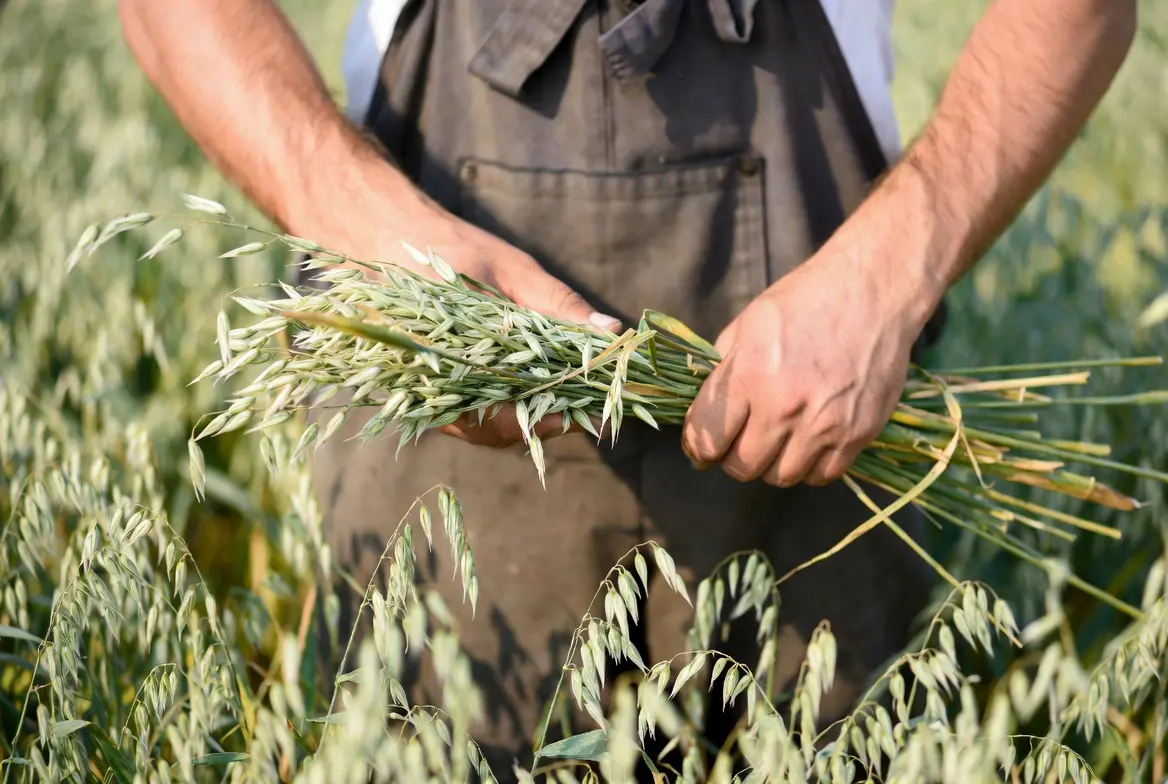
✂️ Harvesting Oats for Chickens
Harvesting oats at the correct maturity is important for both feed quality and storage safety. Mature seed heads should be collected during dry weather, thoroughly dried, and protected from moisture, mold, insects, and contamination before feeding or storing.
- Inspect several heads. Confirm that most grain is mature and firm rather than soft or milky.
- Choose dry weather. Avoid harvesting saturated plants immediately after rain or heavy dew.
- Cut the panicles. Use hand pruners, shears, or a suitable cutting tool and leave enough stem for easy handling.
- Collect the heads carefully. Use a clean basket, bucket, sheet, or tarp to reduce grain loss.
- Separate questionable material. Discard heads with visible mold, severe weathering, insects, unusual discoloration, or foul odor.
- Move the harvest under cover. Protect it from rain, dew, birds, rodents, and chickens.
- Finish drying before storage. Spread heads thinly and provide strong airflow.
🌬 Drying Whole Oat Seed Heads
Whole oat heads may be used for flock enrichment, but they must be dried carefully before storage.
For a small harvest:
- Spread heads in a thin layer
- Use racks, screens, or mesh trays
- Provide dry moving air
- Keep them out of rain and nighttime dew
- Turn or rearrange the heads periodically
- Remove damp stems and green material
- Inspect for heating, mold, insects, and off odors
- Do not seal damp heads in buckets or plastic bags
Moisture may remain inside the grain or within stems and dense portions of the harvest.
🧺 How to Thresh Oats by Hand
Threshing separates mature oat grain from dried panicles.
Small quantities may be threshed by:
- Rubbing dry panicles between gloved hands
- Beating dry heads gently inside a clean container
- Working heads inside a durable clean bag
- Using a hand-cranked grain thresher
- Using a small powered grain thresher
The resulting mixture may include:
- Whole oats
- Loose hulls
- Chaff
- Stem pieces
- Dust
- Weed seeds
- Immature kernels
- Insects
Threshing creates dust and airborne plant material. Work outdoors or with strong ventilation and use suitable protective equipment when needed.
🌬 Winnowing and Cleaning Oats
Winnowing uses airflow to separate lighter chaff from heavier grain.
For a small batch:
- Work over a large tarp or container
- Pour the mixture slowly in front of a gentle fan or breeze
- Use mild airflow to avoid losing good grain
- Repeat the process as necessary
- Remove stems, stones, insects, and damaged kernels by hand
- Screen the grain if suitable screens are available
- Dry the cleaned grain again when moisture remains uncertain
Do not store grain mixed with damp stems, green material, or wet chaff.
🪣 Storing Whole Oat Grain
Store only sound, clean, adequately dried, cool oats.
A suitable storage container should be:
- Food safe
- Clean and dry
- Rodent resistant
- Insect resistant
- Protected from sunlight
- Protected from excessive heat
- Kept away from damp floors and walls
- Accessible for routine inspection
Watch for:
- Condensation
- Heating
- Clumping
- Webbing
- Adult insects or larvae
- Musty, sour, or rancid odor
- Discoloration
- Visible mold
- Rodent contamination
Whole grain generally stores better than cracked or ground grain. Process only the amount expected to be used within a reasonable period.
Intact heads are bulky, contain more plant material, and may be harder to inspect, dry evenly, and protect from pests.
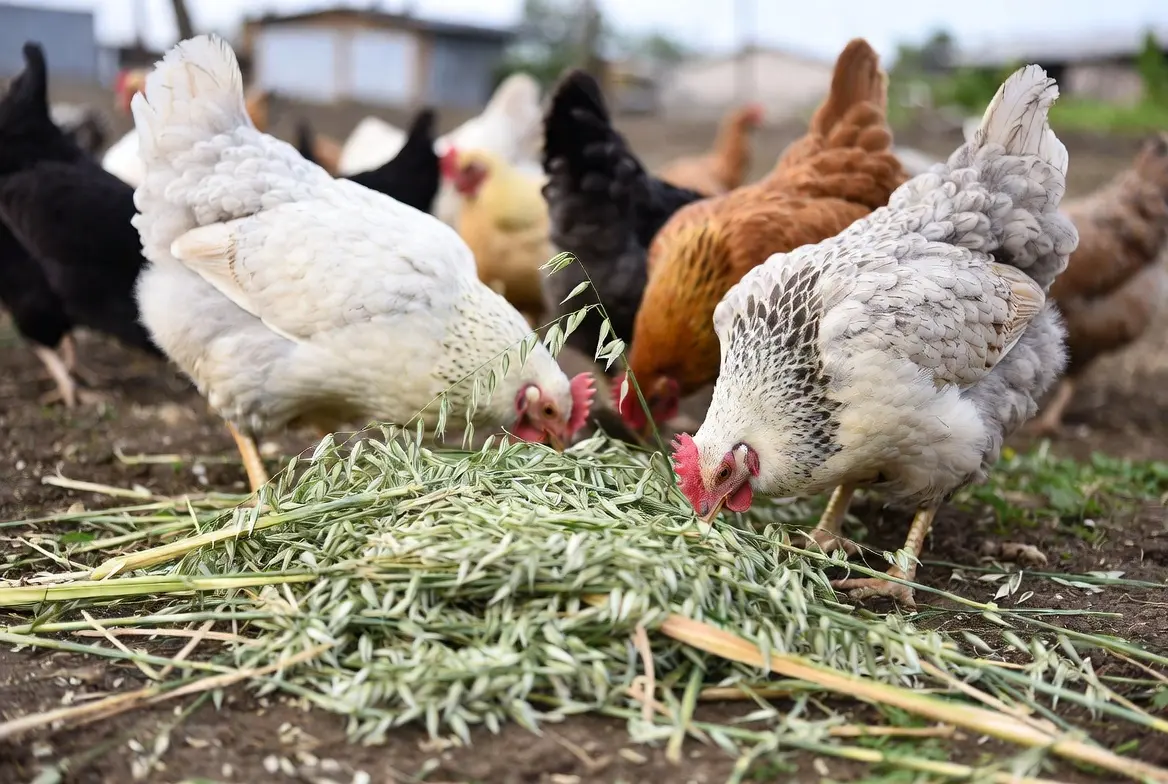
🐔 Feeding Oats to Chickens
Clean mature oats can be offered as a supplemental grain, whole seed-head enrichment, or controlled forage. Oats should complement a balanced poultry ration rather than replace complete feed.
Clean mature oats may be offered in several ways:
- Whole dry grain
- Coarsely ground grain
- Whole thoroughly dried seed heads
- Young cut-and-carry forage
- Protected living forage
- A measured ingredient in a properly balanced poultry ration
Whole dried seed heads may be secured inside the run so chickens can peck grain loose as enrichment.
Adult chickens eating whole oats should have access to appropriate insoluble grit.
Oats do not provide the calcium, amino-acid balance, vitamins, minerals, or usable energy required to replace complete poultry feed.
🥗 Oat Nutrition for Chickens
Average ordinary whole hulled oats contain approximately:
| Nutritional Measure | Approximate Value | Why It Matters |
|---|---|---|
| Crude protein | Approximately 11% | Moderate for a cereal grain but not a complete amino-acid source for laying hens. |
| Crude fat | Approximately 4% | Higher than several other cereal grains and contributes dietary energy. |
| Crude fiber | Approximately 10.5% | The attached hull makes ordinary oats relatively high in fiber and lowers usable poultry energy. |
| Calcium | Approximately 0.10% | Far below the calcium needs of productive laying hens. |
| Total phosphorus | Approximately 0.25% | Only part of the phosphorus is readily available to poultry. |
| Available phosphorus | Approximately 0.14% | Demonstrates why total phosphorus does not equal usable phosphorus. |
Oat composition varies with variety, climate, fertility, hull percentage, grain quality, storage, and processing.
🌾 Why Oats Provide Less Usable Energy Than Corn
Ordinary oats differ from corn, millet, and grain sorghum in two important ways.
The hull adds substantial fiber
The oat hull may represent a large portion of the whole seed. Poultry do not digest fiber as efficiently as grazing livestock, so more hull generally means less usable dietary energy.
Oats contain beta-glucans
Beta-glucans can bind water and increase intestinal viscosity. In formulated poultry diets, commercial enzymes may be used to reduce these effects.
Processing may change particle size, but it does not turn ordinary hulled oats into hull-less oats or create a nutritionally complete feed.
🌽 Oats Compared with Other Homegrown Grains
| Feature | Oats | Warm-Season Grains |
|---|---|---|
| Primary growing season | Cool season | Usually warm season |
| Heat tolerance | Low to moderate | Generally higher for corn, millet, and sorghum |
| Drought tolerance | Low to moderate | Higher for millet and grain sorghum |
| Whole-grain fiber | Relatively high because the hull remains attached | Usually lower for corn and sorghum |
| Usable poultry energy | Moderate | Generally higher for corn and sorghum |
| Fresh forage value | Useful during cool vegetative growth | Varies substantially by crop and growth stage |
| Whole-head enrichment | Good when properly dried | Also useful with millet, sorghum, and sunflowers |
| Cover-crop value | Strong | Varies by crop |
⚠️ Oat Feeding Limitations
- Do not use oats as the flock’s complete ration.
- Do not assume ordinary hulled oats have the same nutritional value as naked oats or groats.
- Do not feed moldy, damp, heated, musty, rancid, or contaminated oats.
- Do not feed chemically treated planting seed.
- Do not rely on oats to supply enough calcium for laying hens.
- Do not overfeed scratch grain and displace complete poultry feed.
- Do not assume grinding corrects fiber, mineral, vitamin, or amino-acid limitations.
- Do not store cracked or ground oats as long as sound whole grain.
- Introduce unfamiliar supplemental grain gradually.
- Provide appropriate grit when adult chickens consume whole grain.
- Keep young chicks on an age-appropriate complete starter ration.
☠️ Never Feed Chemically Treated Oat Seed
Do not feed treated seed to chickens. Do not allow chickens access to spilled treated seed or freshly planted areas where they may uncover and consume it.
When a crop or leftover seed may be fed, obtain untreated seed and retain the supplier label and lot information.
📊 Are Oats Worth Growing for Chicken Feed?
Oats may be especially worthwhile where a grower wants a cool-season crop that serves several purposes.
Potential advantages include:
- Cool-season production
- Fresh green forage
- Whole-head enrichment
- Stored whole grain
- Inexpensive seed
- Simple direct planting
- Ground cover
- Erosion control
- Nitrogen capture
- Green-manure and compost biomass
- Seed-saving potential
- Household food potential with appropriate varieties and processing
Potential disadvantages include:
- Winter-kill risk
- Lower heat and drought tolerance
- High hull fiber
- Beta-glucans
- Lower usable poultry energy
- Lodging
- Rusts, smuts, viruses, and leaf diseases
- Wild-bird and rodent losses
- Harvesting and threshing labor
- Need for careful drying
- Stored-grain insects
- Low purchased-grain prices
- Incomplete poultry nutrition
Oats often provide their greatest value when forage, soil protection, education, flock enrichment, garden rotation, and grain production are considered together.
🌾 A Simple Beginner Oat Plan
For a first attempt, plant a small sunny bed with untreated oats adapted to your region and season.
- Choose spring oats in a cold-winter region or adapted winter oats in a mild-winter region.
- Prepare a clean, firm seedbed.
- Plant approximately 1–1½ inches deep.
- Keep the seed zone moist through emergence.
- Protect the young stand from chickens.
- Use one portion as cut-and-carry forage.
- Protect another portion until seed heads mature.
- Harvest several mature heads during dry weather.
- Dry them thoroughly under cover.
- Offer one clean dried head as flock enrichment.
- Thresh a small batch to evaluate processing labor.
- Store only clean, dry, cool grain.
This trial will show whether cool-season growth, forage value, wild-bird pressure, drying, threshing, and storage make oats practical on your property.
❓ Frequently Asked Questions
Can chickens eat oats?
Yes. Adult chickens can eat clean mature oats as a supplemental grain. Oats provide energy, fiber, and enrichment value, but they should not replace a complete poultry ration.
Can chickens eat whole oats?
Yes. Adult chickens can generally consume whole mature oats when appropriate grit is available. Whole oats should be offered in moderation as part of a balanced feeding program.
Can chickens eat oatmeal?
Yes. Plain cooked oatmeal without added sugar, salt, milk, or flavorings may be offered occasionally as a supplemental treat. Oatmeal should not replace a balanced poultry ration and should be allowed to cool before feeding.
Do oats need to be cooked for chickens?
No. Clean mature oats do not normally require cooking for adult chickens. They may be offered whole or coarsely processed depending on how they are being used.
Can chickens eat growing oat grass?
Yes. Chickens may eat young oat leaves and green forage, but unrestricted access can destroy young stands by scratching, uprooting, and overgrazing.
Can chickens eat oat sprouts?
Yes. Young oat sprouts may be offered as a supplemental green forage. Sprouted oats provide moisture and enrichment but should still be used alongside a complete poultry feed.
Can chickens eat whole oat seed heads?
Yes. Mature oat seed heads may be offered as enrichment when they are thoroughly dried, clean, untreated, and free from mold, insects, rodents, and chemical contamination.
Are oats high in protein?
Whole hulled oats contain moderate protein, often around 11%, but protein percentage alone does not mean oats provide a complete amino acid profile for poultry.
Are oats high in fiber?
Yes. Ordinary whole oats are relatively high in fiber because the hull remains attached to the grain. This reduces their usable energy compared with lower-fiber grains such as corn.
Can chickens eat oat hulls?
Chickens may consume the hull portion of whole oats, but oat hulls are high in fiber and are not efficiently digested. This is one reason ordinary hulled oats provide less usable energy than some other grains.
Are hull-less oats better for chickens?
Hull-less or naked oats are generally lower in fiber and higher in energy than ordinary hulled oats. They may have improved feeding value, but they still should only be used as part of a balanced diet.
Are oats better than corn for chickens?
Not necessarily. Oats provide useful fiber, enrichment, and cool-season production value, while corn generally provides more concentrated energy. The better choice depends on the feeding goal and the overall ration.
Can oats replace layer feed?
No. Oats do not provide enough calcium, balanced amino acids, vitamins, minerals, or concentrated energy to replace a complete layer feed.
Are oats a winter crop?
Oats are a cool-season crop. They are commonly planted in spring in colder regions and during fall in mild-winter regions. Winter survival varies by variety and local conditions, and oats are generally less winter hardy than rye or wheat.
Will fall-planted oats survive winter?
That depends on the variety, region, planting date, establishment, soil conditions, snow cover, and winter temperatures. Oats are generally less winter hardy than crops such as rye or wheat.
Will oats grow back after chickens eat them?
Oats may regrow after moderate clipping while still vegetative, but repeated close grazing, scratching, drought, heat stress, or removal of the growing point can prevent useful regrowth.
Will growing oats lower my feed bill?
That depends on usable forage or grain yield, seed cost, water, fertility, wildlife losses, labor, harvesting, processing, storage, and local feed prices. Oats are usually best viewed as a supplemental crop rather than a complete feed replacement.
🌱 Explore More Feed Crops
🧰 Helpful Chicken Planning Tools
📚 Research Sources
This guide was developed from university Extension crop-production resources, national Cooperative Extension poultry references, grain-safety guidance, and the Backyard Chicken Planner feed-crop research database.
Used for oat adaptation, forage and grain uses, planting windows, winter hardiness, variety selection, disease, harvesting, and Southern production guidance.
Used for regional oat planting dates, seeding guidance, harvest periods, and certified-seed information.
Used for field selection, soil drainage, soil pH, fertility, crop rotation, and production management.
Used for whole-oat protein, fat, fiber, calcium, phosphorus, hull variation, beta-glucans, energy limitations, and distinctions between ordinary and naked oats.
Used for cereal-grain structure, hulls, groats, starch, fiber, protein, and general poultry-feed principles.
Used for beta-glucan digestion, intestinal viscosity, nutrient availability, and formulated-feed enzyme context.
Used for winter forage production, spring growth, winter-kill concerns, grazing tolerance, and cool-season mixtures.
Used for general grain drying, cooling, moisture management, insect prevention, and stored-grain inspection principles.