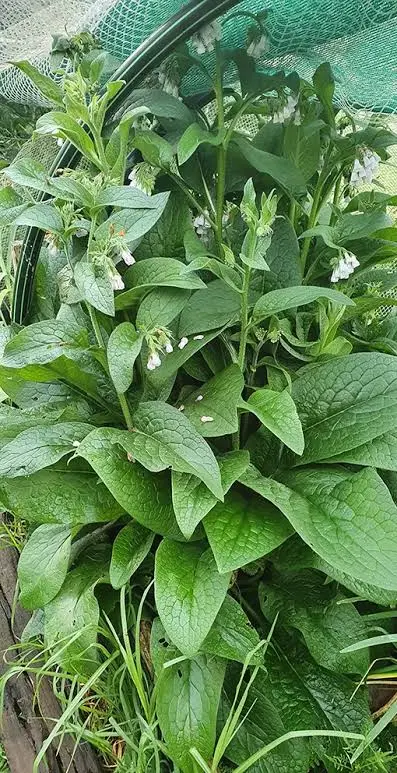
Growing Comfrey for Chickens
Comfrey is a long-lived perennial that produces repeated harvests of leafy biomass for compost, mulch, orchard support, and pollinator habitat. Because it contains pyrrolizidine alkaloids, its strongest role on a chicken property is as a garden-support crop rather than a routine or unrestricted poultry feed.
Comfrey is not recommended as a regular chicken feed ingredient. Because of concerns surrounding pyrrolizidine alkaloids, backyard chicken keepers should treat comfrey primarily as a biomass plant for compost, mulch, soil improvement, and homestead support rather than as a major part of the flock diet.
📊 At a Glance
Perennial Biomass and Garden-Support Crop🌿 Crop Snapshot
🐔 Backyard Chicken Planner Recommendation
Comfrey deserves a place in some chicken-garden systems, but its role should be clearly defined. It is exceptionally useful for producing repeated loads of leafy biomass that can be added to compost, used as surface mulch, placed beneath orchard trees, or used to support the soil around other feed crops.
Its value as a direct chicken feed is much less certain. Comfrey contains pyrrolizidine alkaloids, and the concentration of those compounds can vary among species, cultivars, plant parts, ages, and growing conditions. Limited research should not be interpreted as permission for unrestricted backyard feeding.
Best For
- Gardeners wanting a long-lived perennial biomass crop.
- Chicken keepers who actively maintain compost piles.
- Orchard systems needing recurring surface mulch.
- Pollinator gardens near chicken-feed crops.
- Properties with a permanent location for a difficult-to-remove plant.
- Growers willing to cut foliage several times each season.
- Homesteaders who understand the difference between soil support and complete animal nutrition.
Think Twice If
- You want a plant that can be moved or removed easily.
- You intend to till the planting area regularly.
- You cannot prevent chickens from stripping new growth.
- You expect comfrey to replace purchased poultry feed.
- You plan to feed large or repeated quantities without veterinary nutrition guidance.
- You do not know whether the plant can produce viable seed.
- You have only a small garden where one permanent crown could become inconvenient.
📋 Comfrey Quick Facts
Comfrey is valued less for a single edible harvest than for its ability to return each spring and produce large quantities of foliage. The crop can support a diversified feed garden indirectly by supplying compost ingredients and mulch around safer poultry-feed plants.
Comfrey is generally easy to establish, but poor site selection can create a permanent management problem.
Established crowns may produce several heavy foliage harvests during a favorable growing season.
The soft leaves break down readily when mixed with dry, carbon-rich compost materials.
Freshly cut or partly wilted foliage can be placed on the soil around established plants.
The top growth commonly dies back during winter while established crowns survive underground.
Plants tolerate summer warmth but may wilt or slow during prolonged heat and drought.
Bell-shaped flowers are attractive to bees and other visiting insects.
Roots can penetrate deeply, and living fragments left in the soil may produce new plants.
Pyrrolizidine alkaloid concerns make intentional routine feeding difficult to recommend.
🧭 What You’ll Learn
This guide explains how to choose an appropriate comfrey type, select a permanent planting location, establish roots or crowns, manage repeated harvests, prevent unwanted spread, protect the crop from chickens, and use the foliage primarily as a garden-support resource.
🐔 Is Comfrey a Good Crop for Chickens?
Comfrey can be a good crop for a chicken property without being a good routine chicken feed. This distinction is important. A productive comfrey patch can generate foliage for composting chicken bedding, mulching fruit trees, protecting soil, feeding decomposer organisms, and supporting crops that produce safer flock supplements.
Comfrey is best viewed as a support crop for a chicken-friendly homestead. Its greatest value comes from producing large amounts of reusable plant material for compost, mulch, soil improvement, and garden fertility. It can complement a backyard chicken system without being treated as a replacement for complete poultry nutrition.
Comfrey is one example of a perennial plant that supports a larger chicken-friendly garden system. Other long-lived crops such as mulberry , alfalfa , and white clover provide different benefits including forage, biomass production, soil improvement, and habitat support.
Some poultry keepers report that chickens peck comfrey leaves, and experimental studies have examined controlled comfrey products or measured additions to formulated diets. Those observations do not establish an unrestricted safe amount for backyard birds. Plant chemistry and total exposure remain difficult to control outside a designed feeding trial.
If you are researching plants for your flock, visit our What Can Chickens Eat? guide to compare common garden plants, crops, and supplemental foods while understanding their benefits, limitations, and feeding considerations.
- It returns for many years without annual replanting.
- It produces large leaves suitable for composting.
- Cut foliage can cover bare soil around established plants.
- Flowers support bees and other insects.
- Dense growth can suppress some competing weeds.
- It can occupy awkward edges outside frequently cultivated beds.
- It supplies repeatable biomass for orchard and garden systems.
- It can help turn chicken bedding into finished compost.
A plant may be productive, mineral-rich, palatable, or historically used as forage while still containing compounds that make unrestricted feeding inappropriate. Comfrey should be evaluated according to both its useful properties and its toxicological uncertainty.
Comfrey cannot provide the correctly balanced energy, amino acids, calcium, phosphorus, vitamins, minerals, and other nutrients required by chicks, laying hens, breeding birds, or meat birds. Pyrrolizidine alkaloids create an additional reason not to depend on it as a ration ingredient.
🌱 Is Comfrey Right for Your Backyard?
- Good fit: Homesteads wanting a low-maintenance perennial biomass plant for compost, mulch, orchard systems, or soil improvement.
- Less ideal fit: Chicken keepers looking for a crop that produces a large amount of edible feed for a small flock.
- Best use: A long-term support plant combined with other forage, feed, and garden crops.
⚠️ Understanding Pyrrolizidine Alkaloids
Comfrey naturally produces a group of compounds known as pyrrolizidine alkaloids. Certain forms can be metabolized into reactive compounds capable of damaging the liver. Risk depends on the exact alkaloids present, dose, frequency, duration, plant material, animal species, and individual susceptibility.
Alkaloid concentration is not identical in every comfrey plant. Roots generally present greater concern than leaves, but leaves are not alkaloid-free. Drying, fermenting, wilting, or composting should not be assumed to make material safe for intentional feeding.
The available evidence does not provide a simple universal quantity that can be recommended for every breed, age, production stage, plant variety, harvest date, and growing condition. For that reason, Backyard Chicken Planner does not recommend routine intentional feeding of comfrey.
Roots may contain higher concentrations of pyrrolizidine alkaloids than leaves. Keep exposed roots, crown divisions, and discarded propagation material away from chickens and other animals.
🔬 What Poultry Research Does—and Does Not—Tell Us
Some controlled studies have evaluated measured quantities of comfrey leaves or isolated comfrey-derived products in poultry diets. A study may report acceptable performance or no detectable residues under its exact conditions, while another experiment may demonstrate toxicity from concentrated alkaloids or higher exposure.
These results are not necessarily contradictory. They may involve different species or cultivars, plant parts, extraction methods, concentrations, durations, bird ages, basal diets, and laboratory measurements.
Controlled Diet
Researchers know the amount of material placed into a measured and otherwise balanced ration.
Analyzed Material
Some experiments identify or measure specific compounds in the plant material used.
Monitored Birds
Body weight, blood values, organs, tissues, and other responses may be measured under controlled conditions.
A chicken pecking from a live patch may consume an unknown amount from an untested plant over an unknown period. The rest of the diet, health of the bird, age of the leaves, cultivar, and alkaloid concentration may also be unknown.
🌿 Common Comfrey, Russian Comfrey, and Bocking 14
The name “comfrey” may refer to several Symphytum species and hybrids. Their fertility, growth habits, flower colors, and tendency to spread can differ. Buying a correctly labeled plant is safer than collecting an unidentified roadside or abandoned-garden specimen.
| Type | General Description | Management Consideration |
|---|---|---|
| Common Comfrey | Usually identified as Symphytum officinale and capable of producing viable seed. | May spread from seed in addition to regenerating from disturbed root pieces. |
| Russian Comfrey | Usually identified as Symphytum × uplandicum, a hybrid associated with vigorous biomass growth. | Named selections differ, so fertility and growth claims should be confirmed with the supplier. |
| Bocking 14 | A widely grown vegetatively propagated Russian comfrey selection commonly described as sterile or non-seeding. | It can still spread when roots are divided, dragged, tilled, or moved with soil. |
| Unidentified Comfrey | A plant obtained without a reliable label or known source. | Species, fertility, previous chemical exposure, and planting history may be uncertain. |
A non-seeding selection reduces the risk of seedlings appearing across the property. It is commonly selected where the goal is repeated foliage production rather than seed collection.
Bocking 14 may not spread through viable seed, but living root fragments can still become new plants. Tilling, trenching, digging, grading, or moving contaminated soil can enlarge the patch.
🌱 How Comfrey Grows
Comfrey forms a persistent crown connected to a strong root system. New leaves emerge from the crown in spring, expand into a broad clump, and may produce flowering stalks. After cutting, stored energy in the roots and crown supports regrowth.
-
Spring Emergence
New shoots appear from an established underground crown as soil temperatures rise. -
Rapid Leaf Expansion
Large textured leaves form a dense clump and begin shading nearby soil. -
Flower-Stalk Development
Stems rise above the foliage and produce clusters of hanging bell-shaped flowers. -
Pollinator Activity
Bees and other insects visit the flowers during bloom. -
Biomass Harvest
Foliage may be cut for compost or mulch after the plant is well established. -
Regrowth
New leaves emerge from the crown when moisture, warmth, and stored root energy are sufficient. -
Autumn Decline
Growth slows as days shorten and temperatures fall. -
Winter Dormancy
Top growth may die back while the living crown remains below the soil surface.
Stored energy helps the plant recover after repeated cutting, but that same persistence makes an established crown difficult to eliminate.
🌎 Where Comfrey Grows Best
Comfrey adapts to a wide range of conditions but performs most strongly in soil that remains moderately moist, contains organic matter, drains adequately, and receives full sun or partial shade.
☀️ Full Sun
Usually encourages dense foliage, strong flower production, and faster recovery after cutting when moisture is available.
⛅ Partial Shade
Can reduce heat stress in warm climates, although heavy shade may decrease growth and flowering.
💧 Moist Soil
Supports large leaves and faster regrowth, but chronically saturated roots remain undesirable.
Established comfrey may survive dry weather, but survival is not the same as high production. Leaves may wilt, growth may slow, and recovery after cutting may be delayed when soil moisture is limited.
📍 Choosing a Permanent Location
Site selection is the most important planting decision. Comfrey should be treated as a permanent landscape feature rather than a temporary annual crop. Place it where deep roots and future regrowth will not interfere with buildings, utilities, walkways, septic components, or frequently tilled beds.
- Along an established orchard edge.
- Near a composting area without blocking access.
- At the back of a perennial garden border.
- Beside a fence where mowing will not spread root pieces.
- On the downhill side of a managed garden area.
- In a dedicated perennial biomass strip.
- Near fruit trees while leaving adequate trunk clearance.
- Annual vegetable beds that are tilled each year.
- Future building or driveway locations.
- Directly beside buried pipes or utility work areas.
- Narrow paths where mature leaves will obstruct movement.
- Small raised beds needed for crop rotation.
- Areas where chickens will continually expose the crown.
- Property boundaries where spread may create conflict.
📏 Spacing Comfrey Plants
A mature comfrey crown can occupy substantial space. Crowding plants too closely may reduce airflow, make harvesting difficult, and create a dense permanent patch that is hard to manage.
| Planting Goal | General Spacing Approach |
|---|---|
| Individual Orchard Plants | Allow enough room for a broad mature clump without crowding the tree trunk or mowing route. |
| Biomass Row | Space plants so mature leaves can approach one another while leaving access for cutting and collection. |
| Pollinator Border | Use moderate spacing that allows flowering stalks to develop without creating an impenetrable mass. |
| Small Garden | Begin with one plant and observe its mature footprint before expanding the planting. |
| Container Production | Use one crown per large container unless the container is exceptionally wide. |
One healthy crown can eventually provide propagation material for additional plants. It is easier to expand a useful planting than to remove an oversized one.
🗓 When to Plant Comfrey
Comfrey can be planted during much of the growing season when soil can be worked and adequate moisture is available. Spring is usually the easiest period because mild temperatures and seasonal rainfall support root establishment before summer stress.
| Planting Period | Advantages | Main Concern |
|---|---|---|
| Early to Mid-Spring | Cool conditions, increasing daylight, and an entire growing season for establishment. | Waterlogged or frozen soil may delay planting. |
| Late Spring | Warm soil supports faster emergence from root cuttings. | Young plants may require irrigation as temperatures rise. |
| Summer | Container-grown plants may establish quickly in warm soil. | Heat and drought can stress new roots and transplants. |
| Early Autumn | Cooler weather may reduce transplant stress in mild climates. | Roots need enough time to establish before hard freezing. |
| Winter | Dormant material may be handled in some mild regions. | Frozen, saturated, or poorly drained soil can damage planting material. |
🌱 Choosing Planting Material
Comfrey is commonly started from an established nursery plant, a crown division, or a section of living root. Each option can work, but establishment speed and handling requirements differ.
Nursery Plant
- Already rooted and actively growing.
- Easiest option for beginners.
- Establishes quickly with proper watering.
- Usually costs more than a root cutting.
- Requires trustworthy labeling.
Crown Division
- Contains buds and established root tissue.
- Usually resumes growth quickly.
- Useful when dividing a known plant.
- Creates an open wound on the parent crown.
- Must be planted promptly.
Root Cutting
- Economical and easy to ship.
- Can produce a new plant from a short root section.
- May take several weeks to emerge.
- Can be accidentally planted upside down.
- Requires patience and consistent moisture.
Do not collect plants from roadsides, abandoned properties, or agricultural areas where identity, ownership, herbicide exposure, or other contamination is uncertain.
🪴 How to Plant an Established Comfrey Plant
- Prepare the permanent site. Remove perennial weeds and verify that the location will not need future cultivation or construction.
- Dig a generous planting hole. Make the hole wide enough to spread or comfortably contain the existing root ball.
- Inspect the root ball. Remove damaged container material and confirm that the plant is healthy and correctly labeled.
- Set the crown near the original depth. Avoid burying the central growing point deeply beneath compacted soil.
- Backfill with native soil. Firm the soil gently enough to remove large air pockets without compacting it severely.
- Water thoroughly. Moisten the entire root zone rather than wetting only the soil surface.
- Apply surface mulch. Keep mulch from smothering the central crown.
- Protect the plant from chickens. Use fencing or a sturdy cage until the crown is strongly established.
🌿 How to Plant a Crown Division
A crown division contains part of the central growing crown along with attached roots and visible or dormant buds. It generally establishes faster than a plain root cutting.
- Keep the division cool and moist. Do not leave exposed roots drying in direct sun or wind.
- Identify the upper crown. The bud-producing crown should face upward.
- Prepare a hole large enough for the roots. Avoid forcing long roots into a tight compacted bundle.
- Position the crown near soil level. Cover roots while keeping emerging buds capable of reaching the surface.
- Firm and water the soil. Thorough watering settles soil around the roots.
- Mark the location. A visible marker prevents accidental mowing, digging, or planting over the crown.
- Delay harvest. Allow the division to build roots and leaves before removing substantial foliage.
🌱 How to Plant Comfrey Root Cuttings
Root cuttings may remain invisible for several weeks before new buds reach the surface. A planting that appears inactive may still be forming roots and shoots underground.
- Use firm living root material. Discard pieces that are rotten, badly desiccated, or foul smelling.
- Determine orientation when possible. Plant vertical pieces with the crown-side end upward. Lay uncertain pieces horizontally.
- Plant shallowly enough for emergence. Cover the root with a modest layer of soil rather than burying it deeply.
- Water the planting zone. Maintain moderate moisture without creating saturated soil.
- Mark the exact location. This prevents weeding or digging out the cutting before it emerges.
- Control nearby weeds. Young shoots should not have to compete with established grass or aggressive weeds.
- Wait patiently. Root cuttings may require several weeks to produce visible shoots.
Crown divisions often emerge faster than plain root sections. Continue reasonable moisture and protection before disturbing the planting site to search for the cutting.
✂️ Dividing an Established Comfrey Crown
Comfrey can be multiplied by dividing an established crown, but the process almost always leaves living root material behind. Those remaining roots may produce additional plants at the original site.
- Choose a healthy mature plant. Avoid dividing a newly planted, drought-stressed, diseased, or severely weakened crown.
- Cut back excessive foliage. Removing part of the top growth makes the crown easier to handle.
- Dig around the selected section. Use clean tools and avoid scattering root pieces through nearby beds.
- Separate a portion of crown and root. Each division should contain healthy buds and adequate root tissue.
- Replant promptly. Do not allow divisions to dry while exposed.
- Collect loose root fragments. Pieces left in pathways, compost, or cultivated beds may establish new plants.
- Monitor both sites. Expect regrowth from the original crown and possible shoots from roots left behind.
Do not divide comfrey over an area where dropped roots can disappear into loose soil. Clean tools, footwear, tarps, and containers before moving to another garden bed.
💧 Water Requirements
Young comfrey plants need dependable moisture while roots establish. Mature plants are more resilient, but repeated high-volume foliage production still requires water.
| Growth Stage | Water Management |
|---|---|
| New Root Cutting | Keep the surrounding soil moderately moist but not saturated while buds and roots develop. |
| New Crown Division | Water deeply after planting and continue whenever the root zone begins drying. |
| First Growing Season | Provide consistent moisture during extended dry weather to support root establishment. |
| Mature Plant | Deep occasional watering is generally better than frequent shallow sprinkling. |
| After Biomass Harvest | Moisture supports rapid regrowth, especially during warm or windy weather. |
| Winter Dormancy | Established outdoor crowns usually require little additional irrigation in normal winter conditions. |
Comfrey appreciates moisture but should not be planted where the crown remains submerged or oxygen is continuously excluded from the root zone.
🌱 Soil Fertility and Compost Use
Comfrey grows most vigorously in fertile soil with adequate moisture. Finished compost may be applied around the plant, especially where repeated leaf harvest removes substantial biomass.
- Test the soil when serious nutrient problems are suspected.
- Add finished compost around established crowns.
- Maintain organic surface mulch between harvests.
- Return some plant residue to the surrounding soil.
- Prevent bare soil from eroding around the crown.
- Use chicken-manure compost only after appropriate handling and decomposition.
Do not heap fresh chicken manure directly against the crown. Concentrated salts, ammonia, heat, pathogens, and nutrient imbalance may damage plants or create environmental problems.
🌾 Weed Management
Established comfrey forms a dense clump that shades nearby soil and competes effectively with many weeds. New plants, however, can be overwhelmed by grass and aggressive perennial weeds before their crowns expand.
- Remove perennial weeds before planting.
- Mark root cuttings so new shoots are not mistaken for weeds.
- Pull weeds while they are small.
- Avoid deep cultivation near comfrey roots.
- Use surface mulch around, but not over, the central crown.
- Prevent vines from climbing and smothering flowering stems.
- Do not use a tiller to control weeds beside established plants.
A rotary tiller may chop comfrey roots into many viable fragments and distribute them through the bed. Use shallow hand weeding and surface mulch instead.
🐝 Flowers and Pollinator Value
Comfrey produces curled clusters of hanging, bell-shaped flowers that may be purple, blue, pink, cream, or other shades depending on the plant. Bees frequently visit the blossoms.
- Provides forage for visiting bees.
- Adds seasonal biodiversity.
- Creates an attractive perennial feature.
- Supports insect activity near orchard and garden crops.
- Extends the usefulness of a planting beyond biomass production.
When growing common comfrey or another fertile type, remove flowering stalks before mature seed develops if seedlings are not wanted. A sterile selection may be preferable in small managed gardens.
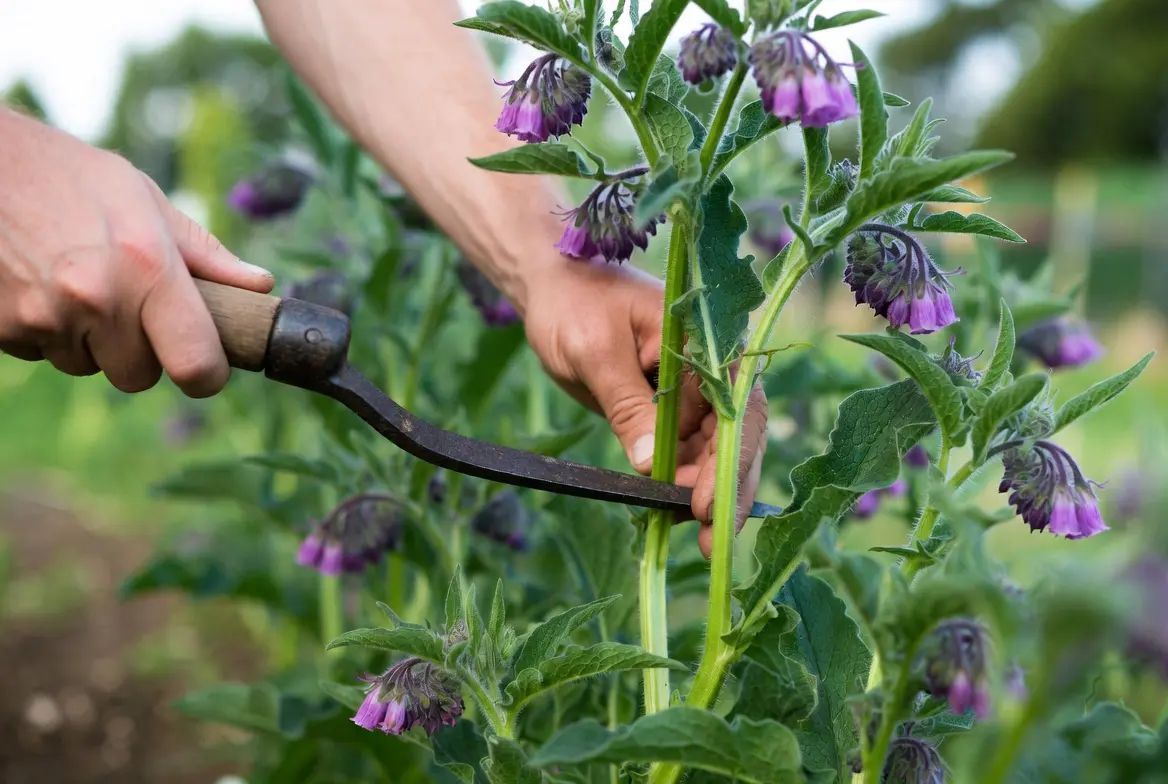
🌿 Harvesting Comfrey for Homestead Use
Comfrey can be harvested repeatedly throughout the growing season once established. Backyard chicken keepers commonly use harvested leaves as compost material, mulch, and nutrient-rich biomass rather than relying on it as a primary poultry feed ingredient.
✂️ When to Begin Harvesting Comfrey
A newly planted crown needs time to establish roots and store energy. Heavy cutting during the first season can delay development and leave the plant vulnerable to heat, drought, cold, or competition.
New Root Cutting
Allow the plant to develop a strong crown and substantial foliage before considering any meaningful harvest.
New Crown Division
Light trimming may be possible after vigorous growth develops, but full repeated harvests should wait until establishment.
Mature Crown
An established plant may support several seasonal cuttings when moisture and fertility are adequate.
Harvest decisions should consider crown age, leaf volume, rainfall, heat, previous cutting, and visible recovery. A stressed plant should be allowed to rebuild.
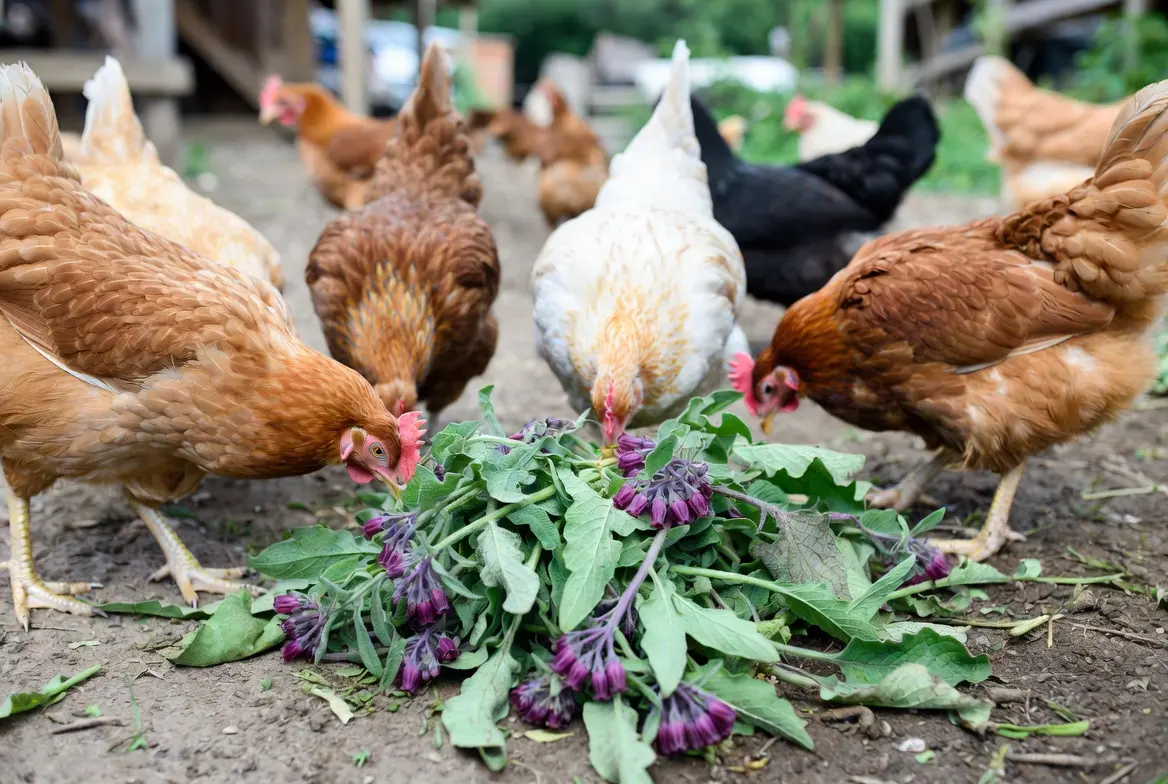
🐔 Comfrey and Chickens
Comfrey is best viewed as a support plant within a chicken-friendly garden rather than a regular feed crop. Its greatest value comes from biomass production, composting, soil improvement, and creating a diverse homestead growing system.
🌿 How to Harvest Comfrey Biomass
- Choose healthy foliage. Avoid badly diseased, contaminated, herbicide-exposed, or moldy leaves.
- Wear gloves and long sleeves. Coarse leaf hairs may irritate sensitive skin.
- Use clean cutting tools. Sharp shears or a harvesting knife reduce tearing.
- Gather leaves into a controlled container. Do not drag cut material through areas where chickens can consume it.
- Leave the crown intact. Avoid chopping into the central crown or exposing roots.
- Allow recovery. Wait for substantial new foliage before harvesting again.
- Match the harvest to immediate use. Move leaves directly to mulch, compost, or another planned garden application.
A heap of fresh comfrey encourages uncontrolled consumption and may become slimy as it breaks down. Use the material in a managed compost or mulch system outside direct flock access.
🔄 Repeated Harvests and Recovery
Established comfrey may regrow after several cuttings during a favorable season. However, every harvest removes leaf area and stored nutrients. Recutting before the plant has recovered can weaken the crown.
| Plant Condition | Recommended Response |
|---|---|
| Large Healthy Leaves and Strong Crown | A planned biomass harvest may be appropriate. |
| Small Pale Regrowth | Delay cutting and evaluate moisture, fertility, shade, or root damage. |
| Recent Drought | Wait for rainfall or irrigation and visible recovery. |
| Immediately Before Hard Frost | Avoid unnecessary severe cutting when the crown is already entering dormancy. |
| Newly Divided Crown | Prioritize root and crown establishment over biomass collection. |
| Flowering Plant Reserved for Pollinators | Delay cutting until the selected flowering period is complete. |
♻️ Using Comfrey in Compost
Comfrey foliage is soft, moisture-rich, and relatively quick to decompose. It works best when mixed with dry carbon-rich material rather than packed into a dense layer by itself.
Comfrey Leaves
Supply soft green plant material and moisture to the compost mixture.
Chicken Bedding
Used wood shavings, chopped straw, or other dry bedding can supply carbon and structure.
Air and Moisture
Proper structure, turning, and moisture allow decomposer organisms to function efficiently.
- Collect healthy leaves. Keep herbicide-exposed or contaminated material out of the compost.
- Chop large leaves when convenient. Smaller pieces mix more evenly and may break down faster.
- Combine with dry materials. Layer or blend comfrey with bedding, leaves, straw, or shredded plant residue.
- Maintain airflow. Avoid compressing wet leaves into an oxygen-poor mass.
- Monitor moisture. The pile should be moist but not waterlogged.
- Allow complete decomposition. Use finished compost rather than partially decomposed manure-rich material around food crops.
When growing a fertile comfrey type, mature seeds may survive a cool or poorly managed compost process. Remove seed heads before maturity or place them in a disposal system that prevents spread.
🍂 Using Comfrey as Surface Mulch
Cut leaves can be laid on the soil around established fruit trees, berry bushes, perennial crops, or other garden plants. As the foliage wilts and decomposes, it covers the soil and becomes organic residue.
- Reduces exposure of bare soil.
- Helps slow surface moisture loss.
- Feeds soil organisms as leaves decompose.
- Adds organic residue to perennial beds.
- Suppresses some small weed seedlings.
- Turns repeated foliage growth into an on-site resource.
Do not pack fresh comfrey against tree trunks, berry canes, vegetable stems, or plant crowns. Leave an open ring for airflow and visual inspection.
Leaves wilt and decompose, but living crown or root fragments may establish new comfrey plants. Inspect harvested material when unwanted spread would be a problem.
🌳 Comfrey in an Orchard System
Comfrey is often planted near fruit trees because it produces repeatable mulch material, flowers for pollinators, and a permanent ground-level plant beneath or near the orchard canopy. The plant should not be crowded directly against a young trunk.
- Source of cut-and-carry surface mulch.
- Seasonal flowers for pollinating insects.
- Dense perennial foliage in selected open areas.
- Biomass for compost used around fruit trees.
- A permanent marker at orchard-row ends.
- Organic residue for paths and planting basins.
Do not allow comfrey to crowd newly planted fruit trees, cover graft unions, conceal vole damage, or make trunk inspection difficult. Maintain a clear area around the trunk.
🐔 Protecting Comfrey From Chickens
Chickens may scratch around a new crown, expose roots, break emerging shoots, compact wet soil, or repeatedly peck young leaves. Even a vigorous mature plant can decline when confined birds have continuous access.
- Fence new plantings before leaves emerge.
- Use mesh small enough to keep chicks away from the crown.
- Anchor cages so birds cannot push underneath.
- Keep exposed roots covered with soil.
- Prevent dust bathing directly over the crown.
- Move cut foliage directly to its planned garden use.
- Do not encourage repeated pecking as a feeding system.
- Inspect protective cages as the plant expands.
Comfrey is easier to manage outside the main chicken run, where foliage can be harvested intentionally for compost or mulch without allowing uncontrolled consumption.
🚧 Containing Comfrey
Containment begins with correct variety selection and permanent site planning. A fertile comfrey type may spread by seed, while all vigorous types may regenerate from living root fragments.
- Choose a non-seeding selection when appropriate. Confirm the cultivar with a reliable nursery.
- Plant outside annual cultivation areas. Avoid locations that will be tilled, trenched, or graded.
- Remove unwanted flower stalks early. Do not wait until mature seed has already formed.
- Harvest with clean tools. Do not carry root fragments into other beds.
- Use a tarp during division. Catch loose roots and soil when working around the crown.
- Inspect moved soil. Soil from near comfrey may contain viable root pieces.
- Monitor the surrounding area. Remove new shoots before they establish deep roots.
Comfrey roots can grow deeply, and barriers may eventually fail, shift, crack, or be bypassed. A container or barrier should not replace thoughtful site selection.
🪣 Growing Comfrey in Containers
Container growing may help gardeners who want comfrey biomass without immediately placing a crown in permanent garden soil. The container must be large, durable, stable, and well drained.
Advantages
- Separates roots from garden soil.
- Allows placement near a compost area.
- Provides more control over expansion.
- Makes experimental growing less permanent.
- Can be moved before roots escape.
Limitations
- Large plants require substantial soil volume.
- Containers dry faster than the ground.
- Roots may escape through drainage holes.
- Freezing may be more severe above ground.
- Plastic containers can crack over time.
Management
- Inspect drainage holes regularly.
- Keep the container off bare soil if escape is a concern.
- Water deeply during hot weather.
- Divide or repot before the crown becomes severely bound.
- Collect every root fragment during repotting.
🍵 Comfrey Liquid Fertilizer
Some gardeners soak comfrey leaves in water to create a concentrated decomposed plant liquid. The mixture can become strongly odorous, anaerobic, and difficult to standardize.
Nutrient content varies according to plant material, water volume, soaking duration, temperature, and decomposition. It should not be treated as a precise replacement for soil testing or a formulated fertilizer.
- Use a covered, stable container.
- Keep children and animals away.
- Do not allow chickens to drink the liquid.
- Prevent overflow into waterways or wells.
- Wear gloves when handling decomposed material.
- Dilute cautiously when applying around plants.
- Stop use if plant injury occurs.
Soaking or fermenting comfrey does not provide a verified method of eliminating pyrrolizidine alkaloids. Concentrated plant liquids should not be added to chicken drinking water.
🍁 End-of-Season Management
In cold climates, comfrey foliage usually declines after frost. Dead top growth may be cut back, composted, or left in a managed location where it will not conceal pests or obstruct access.
- Remove mature seed heads from fertile plants.
- Cut collapsed foliage when it creates a wet mat.
- Leave the underground crown undisturbed.
- Mark dormant plants to prevent accidental digging.
- Add compost around, not over, the crown.
- Repair fencing before spring emergence.
- Plan divisions before vigorous new growth begins.
A cold-weather comfrey crown may disappear completely above ground and return strongly in spring. Keep permanent markers in place.
❄️ Winter Survival
Comfrey is generally considered a hardy perennial. Winter survival depends on cultivar, crown health, drainage, soil exposure, container conditions, and local temperature extremes.
- Plant early enough for roots to establish.
- Avoid chronically saturated winter soil.
- Do not expose the crown through chicken scratching.
- Maintain a modest protective surface mulch.
- Avoid excessive late-season cutting on weak plants.
- Protect containers from repeated freeze-and-thaw stress.
🐛 Pests and Diseases
Comfrey is generally vigorous and may experience relatively few serious pest or disease problems in a well-chosen site. Slugs, snails, chewing insects, crown damage, root disturbance, or foliar spotting may still occur.
| Problem | Possible Signs | Management |
|---|---|---|
| Slugs or Snails | Irregular holes and damaged new growth near the soil surface. | Reduce hiding places, inspect at night, and use flock-safe management methods. |
| Chicken Damage | Exposed crown, scratched roots, broken shoots, and repeated leaf stripping. | Install a physical barrier and redirect birds away from the plant. |
| Drought Stress | Wilting, smaller leaves, slow regrowth, and brown margins. | Water deeply and delay further harvest. |
| Waterlogging | Yellowing, weak growth, crown decline, or root decay. | Improve drainage or relocate new plantings to a better site. |
| Leaf Spots or Rust-Like Symptoms | Discolored spots, damaged foliage, or premature decline. | Improve airflow, remove badly affected foliage, and seek local identification. |
| Unwanted Spread | New plants emerging away from the original crown. | Remove shoots promptly and prevent seed or root movement. |
Do not apply pesticides, herbicides, fungicides, or homemade sprays to material intended for compost, mulch, or use around chickens without verifying the product label and all restrictions.
🌿 Is Comfrey a Dynamic Accumulator?
Comfrey is frequently described online as a “dynamic accumulator” that mines unusually large quantities of nutrients from deep soil and delivers them to the surface. The phrase is commonly used in permaculture discussions, but specific nutrient claims are often repeated without matching soil tests, plant-tissue analysis, or comparisons with other plants.
Comfrey clearly produces useful organic biomass when soil, water, and nutrients support vigorous growth. It also removes nutrients from the soil when leaves are repeatedly carried away.
It is reasonable to describe comfrey as a deep-rooted perennial biomass plant. It is less reliable to promise that it will automatically correct mineral deficiencies or create fertility without nutrients already being available somewhere in the system.
💰 Is Comfrey Economically Worth Growing?
Comfrey does not usually save money by replacing complete chicken feed. Its financial value comes from producing recurring garden material after the initial plant becomes established.
♻️ Repeated Biomass
A permanent crown can supply several foliage harvests without purchasing annual seed each year.
🍂 On-Site Mulch
Cut leaves may reduce the amount of mulch material transported from outside the property.
🌱 Propagation
A known cultivar can be divided to establish additional plants when expansion is genuinely needed.
The crop becomes costly when planted in the wrong location. Removal work, unwanted spread, crowded paths, root contamination in annual beds, or conflict with future construction can exceed the value of the biomass produced.
📊 Comfrey Scorecard
| Category | Assessment | Rating |
|---|---|---|
| Ease of Establishment | Usually dependable from healthy crowns or root cuttings when moisture is maintained. | ★★★★☆ |
| Perennial Reliability | Established crowns are persistent and return for many years. | ★★★★★ |
| Biomass Production | Large leaves and repeated regrowth make comfrey highly productive. | ★★★★★ |
| Compost Use | Soft foliage combines well with dry chicken bedding and other carbon-rich material. | ★★★★★ |
| Mulch Use | Leaves provide useful short-lived surface cover around established plants. | ★★★★★ |
| Pollinator Support | Flowers are attractive to bees and other insects. | ★★★★★ |
| Direct Chicken Feeding | Pyrrolizidine alkaloid concerns prevent a routine feeding recommendation. | ★☆☆☆☆ |
| Containment | Seed-producing types and root fragments may create unwanted spread. | ★★☆☆☆ |
| Ease of Removal | Deep persistent roots make complete removal difficult. | ★☆☆☆☆ |
| Overall Chicken-Garden Value | Highly useful when managed as a permanent biomass and pollinator crop rather than a feed staple. | ★★★★☆ |
✅ Comfrey Planting Checklist
- Confirm the exact comfrey species or cultivar.
- Decide whether a sterile selection is preferable.
- Select a permanent site outside annual cultivation.
- Allow enough room for a mature clump.
- Check drainage before planting.
- Prepare the site by removing perennial weeds.
- Plant healthy roots, crowns, or nursery plants.
- Mark the crown permanently.
- Water consistently during establishment.
- Protect new growth from chickens.
- Delay heavy harvest until the crown is established.
- Use foliage primarily for compost and mulch.
- Prevent roots from entering compost or moved soil.
- Manage flowers before seed matures when necessary.
- Do not treat comfrey as complete poultry feed.
❌ Common Comfrey Mistakes
- Planting comfrey in a bed that will later be tilled.
- Assuming a sterile cultivar cannot spread through roots.
- Placing crowns too close to paths or young trees.
- Harvesting heavily during the first growing season.
- Cutting again before the plant has recovered.
- Allowing chickens to expose the crown.
- Moving contaminated soil into annual garden beds.
- Adding root pieces to a cool compost pile.
- Allowing fertile plants to produce unwanted seed.
- Using unverified roadside plants.
- Assuming drying or fermenting eliminates alkaloids.
- Offering comfrey liquid in drinking water.
- Feeding roots or concentrated extracts.
- Promoting comfrey as a replacement for balanced poultry feed.
❓ Frequently Asked Questions
Can chickens eat comfrey?
Comfrey contains pyrrolizidine alkaloids associated with liver toxicity. Because plant chemistry varies and a dependable safe long-term intake has not been established for backyard flocks, comfrey should not be used as a routine feed ingredient.
Will a chicken be poisoned by one accidental peck?
Risk depends on the amount consumed, alkaloid concentration, repeated exposure, the bird’s health, and other factors. One incidental peck is different from deliberate repeated feeding, but prevent continued access and contact a poultry veterinarian when substantial consumption or illness is suspected.
Can chickens free-range around comfrey?
Occasional incidental contact is difficult to quantify, but unrestricted access allows unknown intake and may damage the crown. Protecting the plant and using it outside the main run provides better control.
Can chicks eat comfrey?
Comfrey is not recommended for chicks. Young birds need a correctly formulated starter ration, and their small body size leaves little room for nutritionally unbalanced or potentially toxic plant material.
Can laying hens eat comfrey?
Laying hens require a balanced ration with adequate energy, amino acids, calcium, phosphorus, vitamins, and minerals. Comfrey should not replace that ration, and routine intentional feeding is not recommended because of pyrrolizidine alkaloid concerns.
Does drying comfrey make it safe?
Drying removes moisture but should not be assumed to eliminate pyrrolizidine alkaloids. Dried comfrey should not be treated as a verified safe poultry feed.
Does fermenting comfrey make it safe?
There is no dependable backyard fermentation method that guarantees removal of harmful alkaloids. Fermentation should not be used to justify intentional feeding.
Can chickens drink comfrey tea?
No. Concentrated plant liquids should not be offered in drinking water. Extraction may move plant compounds into the liquid rather than making them harmless.
Can comfrey be used in chicken compost?
Yes. Healthy leaves may be mixed with dry bedding, fallen leaves, straw, and other compost materials. Keep roots and mature seed heads out when unwanted spread is a concern.
Can comfrey mulch be used near a chicken run?
It can be used around established plants outside direct flock access. Avoid placing large fresh piles where chickens can consume unknown quantities.
How many times can comfrey be cut?
A mature vigorous plant may support several cuts in a productive season, but the correct frequency depends on climate, rainfall, fertility, plant age, and recovery. Do not recut weak or drought-stressed growth.
How long does a root cutting take to emerge?
Emergence may require several weeks. Crown divisions generally produce visible shoots faster than plain root sections.
Does comfrey need full sun?
Comfrey grows in full sun or partial shade. Full sun with adequate moisture usually supports stronger biomass and flowering, while partial shade may reduce heat stress in warm regions.
Does comfrey need a lot of water?
Young plants need consistent moisture during establishment. Mature plants tolerate temporary dry periods, but high biomass production and rapid recovery after cutting require adequate moisture.
Will comfrey grow in poor soil?
Established plants tolerate many soil conditions, but poor fertility, compaction, drought, or waterlogging will reduce growth. Repeatedly removing foliage also removes nutrients from the site.
Is Bocking 14 invasive?
Bocking 14 is commonly described as sterile and therefore presents less seed-spread risk. It can still regenerate from roots moved by digging, tilling, animals, equipment, or soil transport.
Can comfrey be removed?
Removal is possible but may require repeated digging and monitoring because surviving root fragments can produce new shoots. Avoid tilling, which may distribute fragments more widely.
Can comfrey be grown in a raised bed?
It can, but a permanent comfrey crown may eventually occupy valuable rotation space and send roots deeply into or beneath the bed. A separate large container is often a more controllable trial option.
Can comfrey grow in a container?
Yes, when the container is large, stable, and well drained. Inspect drainage holes because roots may escape into the ground.
Is comfrey worth growing for a chicken property?
It can be worthwhile for compost, mulch, pollinators, orchard support, and repeatable biomass. It is less appropriate when the primary goal is producing a direct chicken-feed ingredient.
📚 Research and Extension References
This guide uses conservative recommendations drawn from university extension materials, agricultural crop references, toxicology reviews, and controlled animal-feeding research. Plant performance and legal or veterinary guidance may vary by location.
Guidance concerning perennial growth, preferred sun and soil conditions, spring establishment, moderate moisture, and propagation from roots or crown divisions.
Historical production information concerning establishment, crown divisions, root cuttings, emergence, plant growth, and field-crop management.
Controlled studies examining comfrey leaves or comfrey products in animal and poultry diets under measured experimental conditions.
Scientific information concerning comfrey alkaloids, variation among plant parts, metabolism, potential liver injury, genotoxicity, and animal toxicity.
Practical information concerning the ability of living comfrey root fragments to produce new plants and the difficulty of removing established patches.
Contact your local Cooperative Extension office for perennial planting advice, soil testing, plant identification, invasive-plant concerns, and recommendations suited to your climate and property.
Contact a poultry veterinarian or animal poison resource when a bird consumes a large amount, repeatedly accesses comfrey, or develops weakness, reduced appetite, weight loss, abnormal droppings, abdominal swelling, unusual thirst, reduced egg production, or other concerning signs.