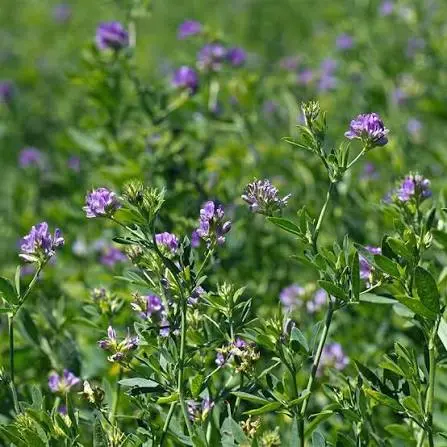
🌿 Growing Alfalfa for Chickens
Alfalfa is one of the most valuable perennial forage crops for backyard chicken keepers because it provides repeated harvests of protein-rich leafy material, improves garden diversity, and can supply seasonal supplemental forage when managed correctly.
🌿 Can Chickens Eat Alfalfa?
Yes. Chickens can eat clean alfalfa leaves, tender stems, properly dried leafy hay, softened alfalfa pellets, alfalfa meal, and fresh alfalfa sprouts as supplemental foods.
Fresh young alfalfa is generally more useful than coarse mature stems because chickens can more easily consume the leafy portions. Properly dried leafy hay may also provide winter forage and enrichment, although long fibrous stems are often ignored.
Practical feeding forms include:
- Fresh leaves and tender stems: Offer clean young growth in small amounts as supplemental forage.
- Properly dried alfalfa hay: Choose leafy, mold-free hay with minimal dust and no musty odor.
- Alfalfa pellets: Plain commercial pellets may be offered dry or softened with clean water. Remove wet leftovers before spoilage begins.
- Alfalfa meal: Commercial dehydrated meal may be used as a measured ingredient in a properly formulated ration.
- Alfalfa sprouts: Clean seed intended for sprouting may be grown under sanitary conditions with good rinsing, drainage, and airflow.
- Controlled grazing: Brief access to an established stand may be possible, but continuous scratching and close grazing can damage crowns and roots.
Alfalfa provides protein-oriented forage, fiber, minerals, and carotenoid pigments, but it is lower in usable energy than grain and does not provide the complete amino-acid, vitamin, mineral, and calcium balance required by chickens. Never feed moldy, damp, heated, chemically contaminated, or spoiled alfalfa.
🌿 Can Chickens Eat Alfalfa? Growing Alfalfa for Chickens
Alfalfa is one of the world’s most important forage crops. It develops a substantial crown and deep root system, then produces repeated leafy growth that can be cut several times during a productive season.
Alfalfa is most valuable when used as a supporting crop within a diverse feeding system. It can provide repeated leafy harvests, enrichment, and supplemental nutrition while other crops provide energy, seeds, and different nutrients.
For backyard chickens, alfalfa may provide:
- Fresh leaves and tender stems
- Repeated cut-and-carry harvests
- Protein-oriented forage
- Carotenoids and other plant pigments
- Fiber and natural pecking material
- Dried leaves or leaf meal
- Winter enrichment when clean hay is stored properly
- Nitrogen fixation and soil-building value
Its limitations include difficult establishment, sensitivity to poor drainage and acidic soil, labor-intensive drying, leaf loss during haymaking, and lower energy value than grain crops.
Growing supplemental feed crops like alfalfa can help reduce dependence on purchased feed. Use our Chicken Feed Cost Calculator to estimate your current feed expenses.
Is This Crop Right for Your Flock and Backyard?
Crop success depends on more than whether chickens can eat it. Climate, growing space, sunlight, soil, water, labor, processing, equipment, harvest goals, and storage all affect whether it is a practical choice for your property.
🌱 Use the Feed Crop Planner →📋 Alfalfa Quick Facts
🌱 Which Type of Alfalfa Should You Grow?
Alfalfa varieties differ in winter hardiness, fall dormancy, disease resistance, pest resistance, yield potential, and suitability for different regions.
Winter-Hardy Alfalfa
Winter-hardy varieties are designed to survive freezing conditions and resume growth after winter.
They are usually the best choice for northern and colder interior regions.
Less-Dormant Alfalfa
Less-dormant varieties may continue growing longer in mild climates.
They can provide more annual cuttings where winter injury is not a major concern.
Grazing-Tolerant Alfalfa
Some varieties are selected for improved crown structure, disease resistance, or persistence under rotational grazing.
They still require rest and should not be expected to survive constant chicken scratching.
Choose a certified variety recommended by your state Extension service, with suitable winter hardiness, fall dormancy, disease resistance, and pest resistance for your region.
🗓 When to Plant Alfalfa
Alfalfa may be planted in spring or late summer, depending on climate, rainfall, irrigation, weed pressure, and winter timing.
| Region | General Planting Approach | Establishment Considerations |
|---|---|---|
| Cold North | Plant in spring after severe freeze risk declines, or during late summer with enough time for establishment before winter. | Select a winter-hardy variety and avoid planting so late that seedlings enter winter poorly rooted. |
| Midwest and Northeast | Spring and late-summer seedings may both work. | Late-summer planting often reduces spring weed pressure but requires dependable moisture. |
| Upper South | Plant in early spring or late summer to early fall, depending on local recommendations. | Avoid exposing very young seedlings to the most severe summer heat and drought. |
| Deep South | Fall planting may be preferable where winters are mild and summer heat is intense. | Choose varieties adapted to local disease, humidity, and drainage conditions. |
| Southwest | Plant during a mild period with reliable irrigation. | Avoid severe heat during establishment and select varieties suited to local salinity and dormancy conditions. |
| Pacific Northwest | Plant in spring or late summer when moisture is dependable. | Drainage, winter injury, irrigation, and variety adaptation differ greatly between wet western and dry inland areas. |
| Coastal West | Plant during mild conditions when soil moisture can be controlled. | Long production seasons may be possible where drainage and disease pressure are managed. |
📐 How Much Alfalfa Should You Plant?
Alfalfa is normally established by seeding rate rather than by spacing individual plants.
The required amount depends on:
- Pure stand versus mixed planting
- Broadcasting versus drilling
- Seed coating
- Seed quality and germination
- Seedbed condition
- Soil moisture
- Expected establishment losses
- Regional production recommendations
A new stand may begin with many seedlings per square foot, but weaker plants die and surviving crowns grow larger over time. Mature plant count is therefore not a dependable measurement of forage productivity.
Use the recommended seeding rate for your region and planting method rather than attempting to count or space each seed individually.
🧪 Soil Testing Before Planting
Alfalfa is less forgiving of unsuitable soil than many beginner garden crops. Testing and correcting the soil before planting is one of the most important steps.
A soil test can identify:
- Soil pH
- Lime requirements
- Phosphorus needs
- Potassium needs
- Organic-matter status
- Possible sulfur or micronutrient concerns
Alfalfa generally performs best in near-neutral soil. Strongly acidic soil can reduce root growth, nodulation, nutrient availability, persistence, and yield.
Lime incorporated before planting is more effective than trying to correct acidity after deep roots and crowns are established.
🪴 How to Plant Alfalfa
- Choose a well-drained site. Avoid areas that remain saturated or collect standing water.
- Test and correct the soil. Apply lime and nutrients according to soil-test recommendations.
- Remove established perennial weeds. Young alfalfa seedlings compete poorly with aggressive weeds.
- Prepare a firm seedbed. The soil should be smooth and firm enough that a footprint sinks only slightly.
- Inoculate when appropriate. Use the correct Rhizobium inoculant if compatible bacteria may not be present.
- Sow shallowly. Alfalfa seed is small and should not be buried deeply.
- Press seed into contact with soil. Rolling or firming the bed can improve moisture contact.
- Maintain moisture during establishment. Prevent the shallow root zone from drying repeatedly.
- Exclude chickens until crowns are established. Seedlings can be scratched out or consumed immediately.
🌱 Does Alfalfa Need Inoculant?
Alfalfa can fix atmospheric nitrogen through compatible bacteria living in root nodules.
Use an inoculant labeled specifically for alfalfa when:
- The field has not grown alfalfa recently
- The soil history is unknown
- The seed is not already pre-inoculated
- Regional recommendations advise inoculation
Keep inoculant cool and protected from sunlight, follow the product label, and plant treated seed promptly.
Nitrogen fixation does not eliminate alfalfa’s need for suitable pH, phosphorus, potassium, sulfur, and other nutrients.
💧 Watering Alfalfa
Alfalfa’s deep roots can make established stands more drought resilient than shallow-rooted leafy vegetables, but productive regrowth still requires moisture.
Water is especially important during:
- Germination
- Seedling establishment
- Rapid spring growth
- Recovery after cutting
- Bud formation
- Extended heat and drought
Avoid frequent shallow irrigation that encourages shallow rooting. Water deeply when needed, while ensuring the soil drains adequately.
Persistent saturation can damage roots and crowns and increase disease pressure.
🌿 How Alfalfa Regrows After Cutting
Established alfalfa stores energy reserves in its roots and crown. After cutting, new shoots emerge from crown buds.
Regrowth depends on:
- Healthy crowns
- Root carbohydrate reserves
- Leaf area remaining after cutting
- Cutting height
- Moisture
- Temperature
- Fertility
- Stand age
- Disease and insect pressure
Cutting too frequently can prevent the plant from restoring root reserves and may shorten stand life.
✂️ When Should Alfalfa Be Cut?
Harvest timing balances forage quality, total yield, drying difficulty, and plant persistence.
Younger alfalfa generally provides:
- More leaves
- Higher protein concentration
- Lower fiber
- Better digestibility
More mature alfalfa generally provides:
- Greater total dry-matter yield
- Thicker stems
- More fiber
- Lower protein concentration
- More difficult drying
For small-scale poultry forage, cutting near the bud to early-bloom stage provides a reasonable balance between leafy quality and plant recovery. Commercial alfalfa is often harvested around the bud or early-bloom stages, depending on management goals.
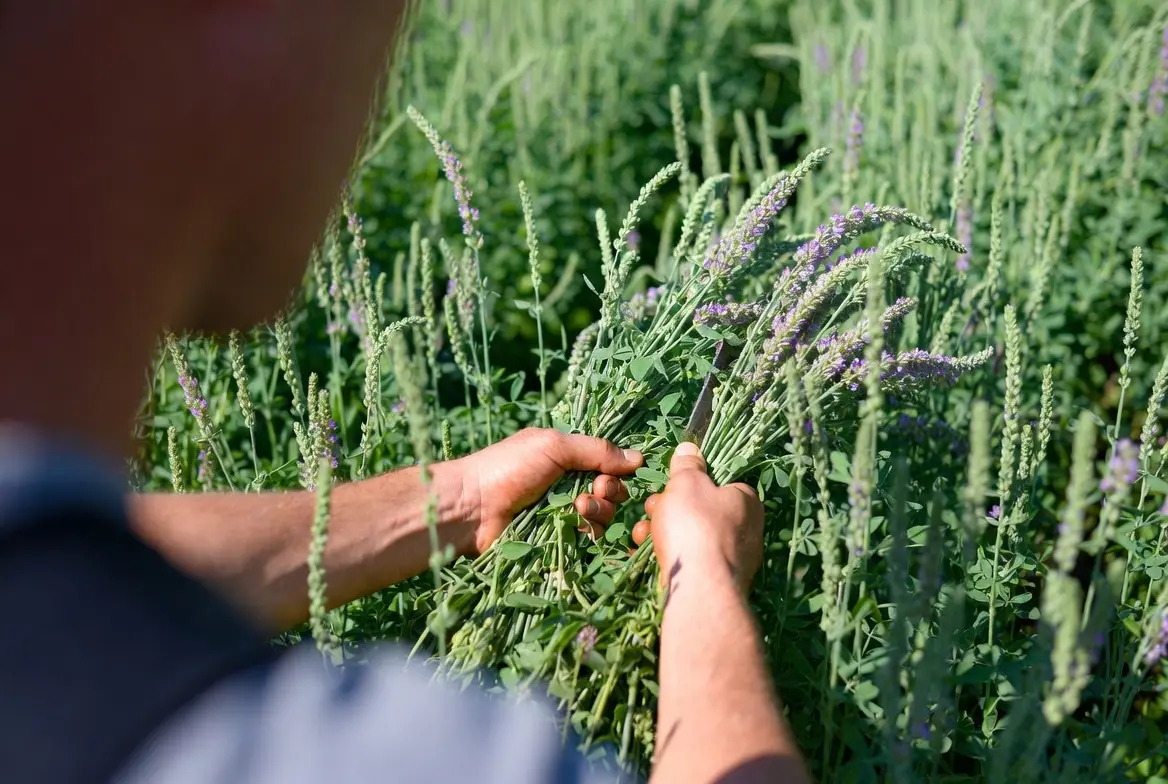
✂️ How to Harvest Alfalfa by Hand
Small-scale harvesting allows backyard growers to cut only the amount needed, protect the stand from overharvesting, preserve valuable leaves, and dry the forage properly before storage or feeding.
- Choose a dry weather window. Avoid cutting immediately before rain.
- Inspect the stand. Do not harvest moldy, diseased, chemically contaminated, or heavily weed-infested material.
- Cut above the crown. Leave enough stubble to protect crown buds and support regrowth.
- Handle leaves gently. Leaves contain much of the crop’s protein and carotenoid value.
- Spread the forage thinly. Good airflow shortens drying time and reduces heating.
- Turn carefully. Excessive handling after leaves become brittle causes valuable leaf loss.
- Store only when fully dry. Do not pack damp forage into sealed containers.
🌬 Drying Alfalfa Safely
Alfalfa stems dry more slowly than leaves. If forage is stored while the stems remain damp, it may heat, mold, ferment, or spoil.
For a small harvest:
- Cut during dry weather
- Spread forage in a thin layer
- Use shade or indirect sun where practical to preserve leaf quality
- Provide strong airflow
- Turn the forage gently
- Keep it protected from rain and dew
- Separate thick, wet piles
- Discard any material that develops mold or a musty odor
Never seal or tightly pack forage that is still warm, flexible with internal moisture, or cool and damp to the touch.
🍃 Protecting Leaves During Drying
Alfalfa leaves dry faster than stems and become brittle. Rough handling can cause the leaves to shatter and fall away, leaving mostly lower-value stems.
To reduce leaf loss:
- Handle the crop less as it becomes dry
- Turn it before the leaves become extremely brittle
- Move forage during cooler or slightly more humid parts of the day when appropriate
- Use shallow trays or mesh racks for small batches
- Collect fallen clean leaves for meal rather than discarding them
Leaf retention is important because the leaves contain a large share of the protein, minerals, and pigments that make alfalfa useful.
🪣 Storing Dried Alfalfa
Store thoroughly dried alfalfa in a cool, dark, dry, well-ventilated location protected from moisture, rodents, insects, and direct sunlight.
Inspect stored forage for:
- Heating
- Condensation
- Musty odor
- Visible mold
- Dark or wet patches
- Insects or webbing
- Rodent contamination
- Excessive dust
Small quantities may be stored as loose dried leaves, small bundles, crumbled forage, or leaf meal. Avoid crushing the crop into fine airborne dust.
🐔 Can Alfalfa Grow Inside a Chicken Run?
Established alfalfa may tolerate limited clipping or carefully controlled grazing, but it is less suited to permanent heavy chicken traffic than low-growing clover.
Chickens can damage alfalfa by:
- Scratching soil away from crowns
- Breaking crown buds
- Pulling young plants from the ground
- Removing all leaf area
- Compacting wet soil
- Creating dust-bathing holes
Cut-and-carry harvest, rotational access, or protected forage frames are usually more dependable than planting alfalfa directly inside a small permanent run.
🛡 Better Alfalfa Systems for Chickens
Cut-and-Carry Patch
Grow alfalfa outside the chicken area and harvest clean forage by hand.
This protects crowns and allows you to control cutting height and recovery time.
Rotational Paddock
Allow brief access to an established stand, then remove the flock before crowns or soil are damaged.
Rest the paddock until strong regrowth returns.
Dried Winter Forage
Harvest leafy alfalfa during the growing season and dry it for winter enrichment.
Storage requires thorough drying and continued mold monitoring.
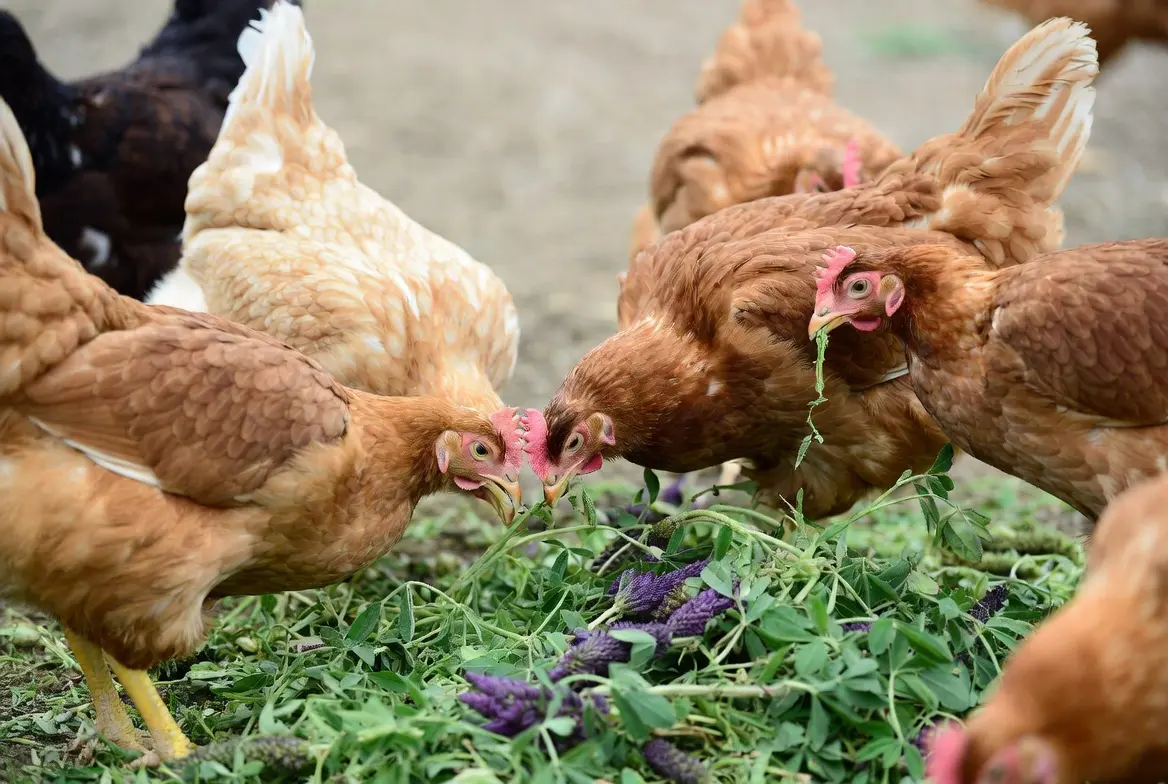
🐔 How to Feed Alfalfa to Chickens
Fresh alfalfa can provide supplemental forage, plant pigments, fiber, and enrichment. Leafy material is generally more useful than mature coarse stems, and alfalfa should complement rather than replace a balanced poultry ration.
Alfalfa may be offered in several forms:
- Freshly cut leaves and tender stems
- Controlled grazing of an established stand
- Properly dried leafy hay
- Dried leaves crumbled into a feeder
- Commercial alfalfa pellets softened with clean water
- Commercial dehydrated alfalfa meal
- A measured ingredient in a properly formulated ration
Long, coarse stems may be ignored and can create waste. Chopping or selecting leafy material improves practical consumption.
Alfalfa provides useful forage nutrients but is fibrous and lower in usable energy than cereal grains. It does not provide the full amino-acid balance or concentrated energy required by productive poultry.
For more information about foods that can safely supplement a flock's diet, visit our complete guide on what chickens can eat .
🥗 Alfalfa Nutrition for Chickens
Alfalfa composition varies greatly with cutting stage, leaf-to-stem ratio, weather, variety, soil fertility, drying, and storage.
| Nutritional Feature | General Contribution | Important Limitation |
|---|---|---|
| Crude protein | Often relatively high in leafy, early-cut forage on a dry-matter basis | Protein declines as stems mature and leaf loss increases. |
| Fiber | Provides forage structure | High fiber limits the amount poultry can use efficiently. |
| Carotenoids | Includes pigments such as beta-carotene and xanthophylls | Light, heat, drying, and storage reduce pigment concentration. |
| Calcium | Alfalfa is relatively calcium rich compared with cereal grains | It still does not replace a balanced layer ration or reliable calcium source. |
| Energy | Provides some digestible nutrients | Usable energy is lower than grain because of fiber. |
Dehydrated alfalfa meal and leaf concentrates are used in some poultry diets, especially for natural pigmentation, but commercial inclusion rates should not be copied directly into an informal backyard feeding system.
🌾 Can Chickens Eat Alfalfa Hay?
Yes, chickens can eat properly prepared alfalfa hay as a supplemental forage source. Alfalfa hay provides dried leafy material containing protein, fiber, minerals, and natural plant compounds that can contribute to a more diverse backyard feeding system.
However, chickens are not designed to digest large amounts of coarse fibrous plant material. They will usually select the leaves and finer portions while leaving behind tougher stems. For this reason, leafy alfalfa hay, chopped alfalfa, or alfalfa leaf meal is generally more useful than mature stem-heavy hay.
Tips for Offering Alfalfa Hay
- Choose clean, mold-free hay with a fresh smell.
- Avoid dusty, spoiled, or damp hay.
- Provide access to grit when offering dried plant material.
- Use alfalfa hay as a supplement rather than a replacement for complete poultry feed.
- Small amounts offered through a feeder, flake, or forage area can provide enrichment.
Although alfalfa contains valuable nutrients, it does not provide the complete balance of energy, amino acids, vitamins, and minerals required for a flock's primary diet.
🌱 Can Chickens Eat Alfalfa Sprouts?
Yes, alfalfa sprouts can be offered to chickens as a fresh supplemental food and enrichment item. Sprouting produces a tender plant material with moisture, fiber, and plant nutrients that many flocks readily consume.
Alfalfa sprouts are especially useful during seasons when fresh pasture or garden forage is limited. They can be grown indoors in small batches, making them a practical option for backyard keepers who want to provide additional variety during winter months.
Tips for Feeding Alfalfa Sprouts
- Use clean seeds intended for sprouting.
- Provide fresh sprouts and remove leftovers before spoilage occurs.
- Introduce new supplemental foods gradually.
- Continue providing a complete poultry ration as the foundation of the diet.
🥚 Can Alfalfa Affect Egg-Yolk Color?
Alfalfa contains carotenoid pigments that may contribute to deeper yellow or orange yolk color when consumed in sufficient quantity as part of the full diet.
Yolk color also depends on:
- The complete feed formula
- Access to grass and other greens
- Corn and other pigmented ingredients
- Season
- Individual hen intake
- Alfalfa processing and storage
Yolk color is not a dependable measure of whether the total diet is nutritionally complete.
⚠️ Alfalfa Feeding and Safety Limitations
- Do not feed moldy, musty, damp, heated, or spoiled alfalfa.
- Do not feed forage contaminated with unsafe pesticides or herbicides.
- Do not harvest alfalfa mixed with unidentified toxic weeds.
- Do not allow long coarse hay to replace significant complete-feed intake.
- Do not assume alfalfa protein is equivalent to balanced poultry protein.
- Do not rely on alfalfa alone for laying-hen calcium needs.
- Do not store wet forage in sealed containers.
- Avoid producing excessive fine dust that may irritate eyes and airways.
- Introduce pellets, meal, or fresh forage gradually.
- Remove wet leftovers before they ferment or mold.
🐛 Common Alfalfa Problems
| Problem | What You May Notice | Possible Response |
|---|---|---|
| Poor establishment | Thin seedlings or bare areas | Check planting depth, soil firmness, moisture, pH, seed quality, and weed competition. |
| Acidic soil | Weak growth, poor nodulation, or short stand life | Use a soil test and correct pH according to regional recommendations. |
| Poor drainage | Yellowing, root decline, thinning stands, or crown disease | Avoid wet sites and correct drainage before planting. |
| Alfalfa weevil | Chewed leaf tips, skeletonized leaves, or larvae in spring growth | Scout regularly and follow local Extension thresholds and treatment guidance. |
| Potato leafhopper | Yellow wedge-shaped leaf-tip damage and stunted regrowth | Use resistant varieties where appropriate and follow regional scouting guidance. |
| Crown damage | Plants fail to regrow after chicken access or close cutting | Protect crowns, raise cutting height, and provide longer recovery periods. |
| Mold during drying | Musty odor, dark patches, heating, or visible growth | Spread forage more thinly, increase airflow, and discard affected material. |
🌱 Maintaining an Alfalfa Stand
A productive stand requires more than planting once and forgetting it.
Long-term maintenance may include:
- Soil testing
- Potassium and phosphorus management
- Weed control
- Insect scouting
- Disease-resistant varieties
- Appropriate cutting intervals
- Protecting crowns from traffic
- Avoiding harvest during saturated soil conditions
- Allowing enough fall recovery before winter
Stand productivity naturally declines over time as crowns age, disease accumulates, and plant populations thin.
📊 Is Alfalfa Worth Growing for Chicken Feed?
Alfalfa may be worthwhile when the grower wants a long-lived, repeated-harvest forage crop rather than a high-energy grain.
Potential benefits include:
- Several harvests per season
- Perennial growth
- Protein-oriented forage
- Carotenoid pigments
- Drying and winter-storage potential
- Nitrogen fixation
- Pollinator flowers
- Deep rooting
- Soil-building value
Its disadvantages include establishment difficulty, strict drainage and pH requirements, drying labor, leaf loss, lower energy value than grain, and poor persistence under continuous chicken access.
For many small flocks, buying clean alfalfa pellets or hay may be cheaper than producing it. Homegrown alfalfa provides the greatest value when soil improvement, pollinators, forage, and gardening experience are also important goals.
🌿 A Simple Beginner Alfalfa Plan
For a first attempt, establish a protected patch of approximately 50–100 square feet outside the permanent chicken run.
- Test the soil before planting.
- Correct pH and fertility in advance.
- Choose a regionally adapted certified variety.
- Prepare a firm, weed-free seedbed.
- Plant shallowly at the recommended seeding rate.
- Keep chickens off the patch during establishment.
- Delay heavy cutting until crowns are well developed.
- Cut a small section near bud or early bloom.
- Dry the forage in a thin layer with strong airflow.
- Offer a small leafy portion and compare flock interest.
This trial will show whether your soil, drainage, climate, and available labor make alfalfa practical before you establish a larger perennial stand.
❓ Frequently Asked Questions
Can chickens eat alfalfa?
Yes. Chickens can eat clean fresh alfalfa, properly dried leafy hay, plain alfalfa pellets, alfalfa meal, and fresh sprouts as supplemental foods. Alfalfa should complement a complete poultry ration rather than replace it.
Can chickens eat fresh alfalfa?
Yes. Chickens may eat clean young alfalfa leaves and tender stems as supplemental forage. Leafy growth is generally more useful than mature coarse stems, and access should be managed so the flock does not destroy the crowns and roots.
Can chickens eat alfalfa hay?
Yes. Choose clean, leafy, properly dried alfalfa hay that is free from mold, excessive dust, weeds, and chemical contamination. Chickens commonly select the leaves and finer pieces while leaving coarse stems.
Can chickens eat alfalfa pellets?
Yes. Plain commercial alfalfa pellets may be offered in moderation. They may be fed dry or softened with clean water, but wet leftovers should be removed promptly before they heat, ferment, or spoil.
Can chickens eat alfalfa meal?
Commercial dehydrated alfalfa meal may be used as a measured supplemental ingredient. Because it is concentrated and finely ground, it is best incorporated carefully rather than offered in unrestricted amounts.
Can chickens eat alfalfa sprouts?
Yes. Alfalfa sprouts may be offered as fresh supplemental forage when they are produced from clean seed under sanitary conditions. Maintain good rinsing, drainage, airflow, and cleanliness, and discard sprouts that become slimy, moldy, discolored, heated, or foul smelling.
Can baby chicks eat alfalfa?
Baby chicks should receive a complete chick starter feed as their primary diet. Small amounts of finely chopped fresh alfalfa may be introduced only after chicks are established on starter feed and are old enough to consume supplemental forage safely.
How much alfalfa can chickens eat?
There is no single amount appropriate for every flock. Alfalfa should remain supplemental, with most nutrition coming from a complete poultry ration. Begin with small portions and avoid offering enough forage, pellets, or meal to reduce normal complete-feed intake.
Can chickens eat alfalfa every day?
Small amounts may be offered regularly, but alfalfa should not become the main part of the diet. Its fiber and lower usable energy make it unsuitable as a replacement for nutritionally complete poultry feed.
Can alfalfa replace commercial chicken feed?
No. Alfalfa provides forage nutrients, protein, fiber, minerals, and carotenoid pigments, but it does not supply the complete energy, amino-acid, vitamin, mineral, and calcium balance chickens require.
Is alfalfa high in protein?
Leafy, early-cut alfalfa can be relatively high in crude protein on a dry-matter basis. Protein concentration and digestibility decline as the crop becomes more mature, stem-heavy, weathered, or damaged during drying and storage.
Does alfalfa make egg yolks darker?
Alfalfa contains carotenoid pigments that may contribute to deeper yellow or orange yolks. The actual result depends on the complete diet, the amount consumed, processing, storage, and each hen’s intake.
Does alfalfa grow back after cutting?
Yes. Established alfalfa can regrow from crown buds when enough root reserves, moisture, leaf area, and recovery time remain. Cutting too frequently or too close to the crown may weaken the stand.
Can alfalfa grow inside a chicken run?
It may survive limited rotational access, but continuous scratching, close grazing, trampling, and dust bathing commonly damage crowns and roots. Cut-and-carry harvest or protected rotational paddocks are generally more dependable.
How long should alfalfa rest after cutting or grazing?
Recovery time varies with temperature, moisture, stand age, cutting height, fertility, and season. Allow strong new growth to develop before cutting again or returning chickens to the area.
Can moldy or dusty alfalfa be fed to chickens?
No. Do not feed alfalfa that is moldy, musty, damp, heated, excessively dusty, chemically contaminated, or spoiled. Questionable forage, pellets, meal, or sprouts should be discarded.
Will growing alfalfa lower my chicken-feed bill?
Possibly, but savings depend on stand yield, soil preparation, harvesting and drying labor, storage losses, climate, and the price of purchased hay, pellets, and complete feed. Its greatest value may come from repeated forage harvests, soil improvement, pollinator support, and enrichment.
🌱 Explore More Feed Crops
🧰 Helpful Chicken Planning Tools
🌱 Related Perennial Chicken Feed Crops
Alfalfa works especially well when combined with other perennial crops that provide forage, shade, enrichment, or seasonal diversity.
- White Clover — low-growing forage and ground cover.
- Comfrey — high-biomass perennial green feed crop.
- Mulberry — perennial tree-based forage source.
📚 Research Sources
This guide was developed from university Extension forage guidance, USDA plant resources, established feed references, and the Backyard Chicken Planner feed-crop database.
Used for cutting stage, regrowth, stand persistence, forage quality, and harvest timing.
Used for establishment, soil preparation, fertility, varieties, pest management, cutting, and storage.
Used for taxonomy, distribution, perennial growth habit, forage use, and regional occurrence.
Used for forage composition, protein, fiber, calcium, carotenoids, poultry applications, and nutritional variability.
Used for balanced-ration principles and the supplemental role of pasture, hay, and forage ingredients.